Academic Policies, Practices, and Forms

Academic Policies, Practices, and Forms
SGS Graduate Policy Guide
NEW Policy Handbook (.pdf downloadable)
1. Purpose, Scope, and Definitions
1.1 Purpose
This guide serves as a comprehensive reference to the university policies most relevant to graduate education at Rowan University. It is designed for graduate students, program directors, faculty, and administrators, and directs readers to the official university policies most commonly encountered in graduate study. It also provides guidance specific to policies administered by the School of Graduate Studies and references program-level handbooks where additional, discipline-specific requirements and procedures may apply.
1.2 Scope
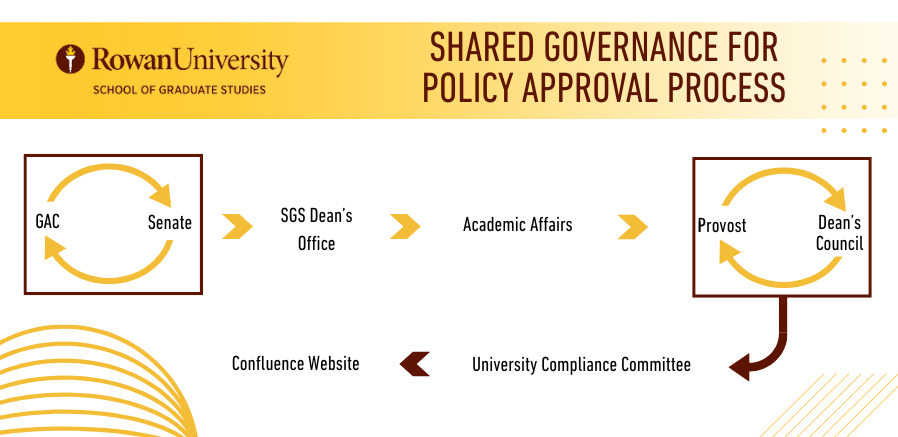
This guide outlines policies that apply to all graduate-level programs at Rowan University. All official University policies are published on Rowan’s Confluence site and take precedence in all matters.
1.3 Relationship to Other Policies and Graduate Program Handbooks
This Graduate Policy Guide articulates University-wide policies and expectations that apply to all graduate students and graduate programs. In addition, each graduate program is expected to maintain a Graduate Program Handbook that describes program-specific requirements, benchmarks, expectations, and discipline-specific resources. Graduate Program Handbooks are intended to supplement this Policy Guide by providing detailed guidance relevant to the academic field and degree program.
All policies articulated in Graduate Program Handbooks are designed to be consistent with the policies set forth in this Graduate Policy Guide. Program handbooks must align with University policy and may provide additional or more specific requirements where appropriate. Where University policy does not provide specific guidance, the School of Graduate Studies and individual graduate programs may establish additional policies or procedures that address graduate-specific, discipline-specific, or accreditation-related needs. These supplemental guidelines support—but do not replace—University policy.
The School of Graduate Studies works collaboratively with graduate programs on an ongoing basis to ensure consistency between this Policy Guide and individual Graduate Program Handbooks. In the event of a question or perceived inconsistency between this Policy Guide and a Graduate Program Handbook, students should consult their Graduate Program Coordinator (or Program Director) for clarification. Program Directors
1.4 Definitions
- Matriculated Student: Admitted and enrolled in a degree or certificate program.
- Regularly enrolled graduate students: Degree-seeking graduate students are considered to be in regular enrolled status within the defined program length.
- Non-Matriculated Student: A non-matriculated student is an individual who has not been formally admitted to a degree or certificate program at Rowan University but is permitted to enroll in courses on a part-time basis with prior University approval, provided they meet course prerequisites and registration requirements. Non-matriculated students are not eligible for federal financial aid. Non-matriculated students may enroll in up to nine (9) graduate credits; students wishing to continue beyond this limit must formally apply to and be admitted into the appropriate graduate program before enrolling in additional coursework.
- Inactive Status: Loss of enrollment eligibility due to time limits, withdrawal, or completion. Students in Inactive Status are prohibited from continued registration. Depending upon the reason for the inactive status, a student may be required to reapply to resume study. A student who is made inactive for one of the outlined reasons may not necessarily receive notification from the University specifically in cases where the student is difficult to reach using the rowan.edu or email address on file.
- Leave of absence: The regular defined program length has been interrupted because the student is not pursuing degree related work.
- MSAP (Minimum Satisfactory Academic Progress): University standards for continuation in a graduate program.
2. Admission and Matriculation
2.1 Admission
- Admission to Rowan University graduate programs is based on approved program criteria. The graduate admissions portal can be accessed here. Programs may require prerequisite coursework, standardized tests, or interviews. For specific Program requirements and questions about graduate assistantships and fellowships, please contact your program coordinator(Program Directors) or advisor (listed in the About Us section of the School of Graduate Studies website). Inquiries may be directed to:
- gradadmissions@rowan.edu for general information
- international@rowan.edu for questions related to international admissions
- onlinestudents@rowan.edu for questions related to admissions to online degree programs
- online@admissions.rowan.edu for questions related to admissions to online degree programs
- Rowan University does not discriminate on the basis of race, color, age, sex, religion, creed, national origin, sexual orientation or disabling condition. University policies are consistent with federal and state laws pertaining to equal opportunity in admissions and education policies and in scholarships, loans, athletics and other school-administered programs.
- NOTE: Admissions to the Cooper Medical School of Rowan University, the Shreiber School of Veterinary Medicine, Rowan-Virtua School of Translational Biomedical Engineering and Sciences, and the Rowan-Virtual School of Osteopathic Medicine are handled separately.
- For Graduate programs in the Rowan-Virtua School of Translational Biomedical Engineering and Sciences, inquiries may be directed to: TBESadmissions@rowan.edu
2.2 Concurrent Applications and Matriculation
- Students may not apply to more than one academic program for the same entry term. However, they may apply to and matriculate in multiple programs at the graduate level with different entry terms, provided all concurrent application and matriculation policies are followed. Not all programs permit concurrent matriculation. Students should contact Graduate Admissions (gradadmissions@rowan.edu) or the academic advisors of the programs in question to confirm eligibility.
- Transitions between degree levels within the same program—such as moving from the Ph.D. to the M.S. or from the M.S. to the Ph.D.—require a formal, documented internal review process. The graduate program must evaluate the student’s request, deliberate as a faculty group, and provide written confirmation of program support for the proposed transition. Following this review, the program must submit the formal request with all supporting documentation directly to Graduate Admissions (gradadmissions@rowan.edu) for processing. Graduate Admissions will coordinate the necessary updates to the student’s academic record in consultation with the Office of Advising and Student Information Services (OASIS) and the School of Graduate Studies (SGS), as needed. Programs should also review concurrent matriculation guidelines to ensure compliance when students may be enrolled in two graduate programs simultaneously.
- Applicants to concurrent degree programs must complete at least six (6) semester hours and one full term before applying to the second concurrent degree.
- For students concurrently enrolled in two graduate programs, tuition and billing are assessed according to the primary program (Program 1) listed in the student’s Banner record.
2.3 Matriculation and Active/Inactive Status
- Graduate students are required to maintain continuous enrollment in every fall and spring term throughout their program of study. Students who fail to register for courses will be placed on Inactive Status after three consecutive terms of non-enrollment (excluding summer).
- Placement on Inactive Status prohibits further registration and may require reapplication to resume studies. Time spent in Inactive Status still counts toward the University’s maximum time limits for degree completion, including the standard limit of 18 consecutive terms from the original term of matriculation for graduate degree programs (see Standard Time Limits section).
- To avoid being placed on Inactive Status, students may request a Leave of Absence. Approved Leave of Absence periods pause the enrollment clock and do not count toward the University’s maximum time limits for degree completion.
2.4 Reactivation and Reapplication
- Students who become inactive should contact their Graduate Program Coordinator (Program Director) to determine the appropriate next steps. Program Coordinators (Program Directors) (listed on the School of Graduate Studies website here) will advise whether the student must reapply or whether reactivation is possible, based on the circumstances of the inactivity. They will also assess which previously completed courses may still apply toward degree requirements, recognizing that program-specific considerations—such as curriculum changes or the evolving relevance of coursework—may affect applicability after a period of inactivity. Program Directors
2.5 Leave-of-Absence and Withdrawals
- Graduate students who wish to take a leave of absence should first consult with their Graduate Program Coordinator(Program Directors) and, if applicable, their research advisor (for students working on a thesis, dissertation, or other capstone project). Approved leaves of absence pause the student’s time-to-degree; the leave period does not count toward the University’s maximum time limits for completing the degree. Students must submit a Graduate Student Leave of Absence Request Form to initiate the leave and, upon returning, complete a Return from Leave Form to resume their studies. The Rowan University Leave of Absence Guidelines, the Leave Request Form, and the Return from Leave Form are available online.
- Graduate Leave of Absence Policy - https://confluence.rowan.edu/spaces/POLICY/pages/109422551/Leave+of+Absence+Policy+Graduate+Students
- Leave of Absence Request Form - https://sites.rowan.edu/sgs/_docs/graduate-student-leave-of-absence-request-form_110824.pdf
- Leave of Absence Intent to Return Form - https://forms.gle/8TicrFnHF2tKxMQH6
- Withdrawal from the University must follow Registrar deadlines found here.
- Students should be aware that a Leave of Absence or Withdrawal may carry financial implications and, for F-1/J-1 international students, visa implications;
- financial support cannot be guaranteed upon return,
- F-1/J-1 international students must submit required documentation and obtain permission from the Rowan International Center (RowanIC@rowan.edu) before initiating a Leave of Absence or Withdrawal.
- Students receiving financial aid should consult with the Financial Aid Office before initiating a withdrawal, as doing so may affect their eligibility for aid and could require them to return any funds already disbursed.
- Students should be aware that University policy limits the number of repeated courses permitted; therefore, repeated withdrawals from courses to avoid receiving a lower grade may negatively affect academic progress and future opportunities to repeat coursework.
- University policy on course repeat is here: https://confluence.rowan.edu/spaces/POLICY/pages/58656060/Repeating+a+Course+Policy
3. Structure and Administration
Graduate education at Rowan University is supported through a collaborative structure of academic, administrative, and student support units. Each plays a distinct and complementary role in ensuring the success of graduate students and the quality of graduate programs. This section outlines the primary entities involved in the structure and administration of graduate education and describes their respective responsibilities.
3.1 School of Graduate Studies (SGS)
- The School of Graduate Studies serves as the central administrative unit responsible for graduate academic policy, oversight, and coordination across the University. SGS provides leadership in graduate academic standards, policy interpretation, degree completion requirements, and adherence to University regulations. SGS collaborates with colleges, departments, program coordinators(Program Directors), and advisors to ensure consistency of application of graduate policies, facilitates graduate program quality assurance, and serves as a resource for students, faculty, and academic administrators.
3.2 Academic Deans and College Offices
- Each academic college is led by an Academic Dean who has institutional authority and responsibility for programs within the college, including graduate programs. The Dean’s Office supports graduate student success, approves program-specific decisions in consultation with SGS, reviews academic matters such as graduate standing and academic petitions, and apportions college-level resources. Academic Deans also play a critical role in faculty governance, program review, and strategic direction for graduate education within their respective colleges.
3.3 Academic Departments and Graduate Program Coordinators
- Graduate programs reside within academic or programmatic departments, which are the primary academic homes for graduate students. Departments provide disciplinary expertise, design and deliver curriculum, mentor students, and evaluate academic progress. Every graduate program has a Graduate Program Coordinator(Program Directors) (and may also have a Director of Graduate Studies) who administers program-specific policies, coordinates admissions decisions in partnership with Graduate Admissions and SGS, advises students on degree requirements, and acts as the main point of contact for program-related academic matters. Departments are responsible for documenting and publishing program-level requirements, milestones, and expectations in their Graduate Program Handbooks.
3.4 Graduate Academic and Research Advisors
- Graduate Academic Advisors: Academic advising within graduate programs is provided by faculty members and/or designated academic advisors assigned to each program. Graduate Academic Advisors assist students in understanding program requirements, selecting appropriate coursework, planning key milestones (e.g., examinations, thesis/dissertation), and monitoring academic progress toward degree completion in consultation with department faculty.
- Graduate Research Advisors: In programs where thesis, dissertation, or capstone research is required, students are assigned a Graduate Research Advisor, who often serves as the Principal Investigator or primary research mentor. Research Advisors provide day-to-day guidance on research activities, methodology, and project development, help set research goals and timelines, and ensure progress toward successful completion of the student’s thesis, dissertation, or capstone project. Not all graduate students have a Research Advisor, as this role applies primarily to students in research-focused or thesis-based programs.
- Mentoring Support: The School of Graduate Studies provides the Rowan Excellence in Mentoring Guide to assist faculty in effectively mentoring graduate students. This guide supports Advisors of both types in fostering student success, guiding professional development, and maintaining clear communication throughout the graduate experience.
- Download the mentor guide here: https://sites.rowan.edu/sgs/_docs/rowan-university-guide-to-excellence-in-graduate-student-mentorship-2_alt-cover-image.pdf
3.5 Office of Advising and Student Information Services (OASIS)
- The Office of Advising and Student Information Services (OASIS) provides centralized student services support for Glassboro campus-based graduate students that complements program-level academic advising. OASIS assists students with general academic onboarding, registration processes, interpretation of University systems, and connections to campus-wide resources and services. OASIS also supports students in understanding University-wide procedures, deadlines, and administrative requirements related to enrollment, course registration, and academic records. Students who are enrolled in 100% online programs are supported by the Online Student Success (OSS) team within Rowan Online.
3.6 Graduate Admissions and Enrollment Services
- Graduate Admissions within the broader University enrollment structure processes all applications for graduate study, verifies admission documentation, ensures compliance with admissions standards, and maintains the centralized student record. Graduate Admissions works in collaboration with SGS, academic or programmatic departments, and program coordinators (Program Directors) to facilitate transitions between programs, to manage dual-degree or special admissions pathways, and to ensure accurate academic coding and reporting. For international applicants, the International Admissions team (internationaladmissions@rowan.edu) manages admissions processes specific to international students, including the review of required international credentials and documentation, and works collaboratively with Graduate Admissions, SGS, and academic programs throughout the admissions process.
- Please note that separate admissions departments for programs in Cooper Medical School of Rowan University, the Shreiber School of Veterinary Medicine, Rowan-Virtua School of Translational Biomedical Engineering and Sciences, and the Rowan-Virtual School of Osteopathic Medicine are handled separately.
- For Graduate programs in the Rowan-Virtua School of Translational Biomedical Engineering and Sciences, inquiries may be directed to: TBESadmissions@rowan.edu
- Please note that separate admissions departments for programs in Cooper Medical School of Rowan University, the Shreiber School of Veterinary Medicine, Rowan-Virtua School of Translational Biomedical Engineering and Sciences, and the Rowan-Virtual School of Osteopathic Medicine are handled separately.
3.7 Collaborative Governance and Shared Responsibility
- No single unit acts in isolation; instead, the governance of graduate education at Rowan University is shared across institutional offices. Academic or Programmatic departments deliver the educational experience; deans provide college-level oversight; SGS ensures policy continuity and academic integrity; Graduate Admissions and OASIS (or OSS) ensure administrative support and procedural compliance; and program coordinators (program directors)/advisors support student progression and success. Together, these units deliver a structured and student-centered graduate education experience.
4. Registration and Credit Policies
4.1 Registration
- Students must register each term by published deadlines following the Rowan University Registrar’s page found here.
- For graduate students, full-time enrollment is defined as 9 credits in the Fall and Spring terms;
- Summer enrollment requirements vary by graduate program. Some programs require students to enroll in 4, 6, or 9 credits during the Summer term to maintain full-time status, while other programs do not require Summer enrollment. Students should consult their Graduate Program Handbook and Graduate Program Coordinator for program-specific guidance regarding Summer registration and full-time enrollment
- Part-time graduate students are enrolled in at least 4.5 credit hours per semester, but fewer than 9 credit hours. Enrollment in 4.5 credit hours is the minimum required for graduate students to be considered for federal financial aid.
- Part-time post-baccalaureate students are enrolled in at least 6.0 credit hours per semester, but fewer than 12 credit hours. Enrollment in 6.0 credit hours is the minimum required for post-baccalaureate students to be considered for federal financial aid.
- Graduate students may register for up to 15 credit hours per semester. Enrollment beyond this limit requires prior approval from the student’s Academic Dean, which must then be submitted to the School of Graduate Studies.
4.2 Course Audits
- Students who wish to audit a course—attending without earning credit or a grade—must follow the University’s procedures and obtain all required approvals; full details are available in Rowan University's Audit Policy found here.
4.3 Course Substitution
- Course substitutions must receive prior written approval from the Graduate Program Coordinator (Program Director) before a student enrolls in the proposed substitute course. The approved substitution must also be documented in the student's Degree Works record through an advisor note or comment entered by the Graduate Program Coordinator. Exceptions in which a student enrolls in a substitute course without prior written approval must be justified and are subject to review and approval.
4.4 Graduate Transcript
- For graduate students, all academic records are maintained on a graduate transcript. All courses taken by graduate students—whether at the graduate or undergraduate (e.g., 400-level) level—are billed at the graduate tuition rate in accordance with the tuition and fee schedule approved by the Board of Trustees (published here). All such courses are applied to the graduate GPA and are governed by graduate academic policies. Undergraduate courses may not be used to satisfy graduate degree requirements. Graduate credits earned while an undergraduate student (at Rowan or another institution) may be eligible for transfer toward a graduate degree if approved; however, the associated grades do not transfer and do not factor into the Rowan Graduate GPA.
4.5 Transfer Credit
- The number of graduate credits that may be transferred toward a Rowan University graduate degree depends on the specific program and degree type:
- Post-baccalaureate and certificate programs may permit the transfer of up to 6 credits.
- Most graduate degree programs allow matriculated students to transfer up to 12 graduate-level credits.
- Transfer credit limits may vary by program, particularly for thesis- or dissertation-based programs.
- Note: Some Programs may establish more restrictive transfer credit limits based on accreditation, curricular design, or program structure. Programs may impose additional criteria including accreditation standards, applicability to elective or core requirements, and alignment with program learning outcomes.
- All transfer credit requests require prior written approval and a Transfer Credit Form (found here) signed by the Graduate Program Coordinator (Program Directors). Students are responsible for submitting the completed form along with an official transcript and the course syllabus for each course they wish to transfer to the Graduate Program Coordinator (Program Directors). The Graduate Program Coordinator (Program Directors) will review the materials, determine whether the coursework meets program requirements and content relevance, and—if approved—submit the signed form to the Registrar’s Office at registrar-transfercredits@rowan.edu.
- To be eligible for transfer, courses must meet the minimum grade requirements of the student’s program category (Category 1, 2, or 3) (unless otherwise approved by the Graduate Program Coordinator/Graduate Program Director).
- Courses may be considered for transfer credit if they were completed within the past 10 years, earned a grade of B or higher (3.0 or above on a 4.0 scale), and are determined to be equivalent to required courses in the student’s intended program.
- For coursework completed at international institutions, transcripts and translated syllabi must be evaluated through a NACES-approved credential evaluation service before being submitted for review. The list of NACES accredited members is located at https://naces.org/members. For questions, email registrar-transfercredits@rowan.edu
4.6 Change in Level or Program
- Graduate students seeking to change their degree program or level (e.g., from one master’s program to another or from a master’s program to a doctoral program in the same or related discipline) must complete a formal application process. Rowan University requires an application on file for the academic program in which a student intends to be enrolled; therefore, all program changes begin with the submission of a new application through the University’s graduate application system.
- Once a student initiates an application to the new program, Graduate Admissions may transfer or reuse previously submitted application materials, as appropriate, to minimize duplicate documentation requirements. Students are responsible for initiating the application, while Admissions will provide guidance and support throughout the process.
- In addition to submitting an application, approval from the receiving academic program is required. The Graduate Program Coordinator (Program Director) (or designee) for the new program must review and formally accept the application. As part of this review, the program will evaluate the student’s graduate transcript and advise the student regarding applicable degree requirements, including any coursework that may transfer or be applied toward the new program.
- A change in program or level is not effective until the application has been submitted, reviewed, and formally approved, and the student’s academic record has been updated accordingly. Students are encouraged to consult with the School of Graduate Studies and the receiving program’s Graduate Program Coordinator (Program Director) early in the process to ensure timely completion and to understand any academic or administrative implications of the change.
4.7 Credit by Examination for Life Experience, Internal Evaluation
- Limited opportunities may exist depending on the program. Approval for Credit by Examination is required. Graduate credit by examination is available only in limited circumstances and at the discretion of the academic program. Eligible matriculated graduate students may request credit for prior knowledge or experience in lieu of course enrollment, provided the credit does not duplicate previously earned coursework, falls within applicable transfer credit limits, and is approved by the academic program. No more than six (6) graduate credits may be earned through credit by examination, and not all programs offer this option. Approved examinations are administered and evaluated by the academic or programmatic department, and any credit awarded is recorded as transfer credit on the student's transcript. Students should consult their Graduate Program Coordinator or Academic Advisor regarding program-specific eligibility, procedures, and fees.
- Policy for Credit by Examination for Life Experience, Internal Evaluation: https://confluence.rowan.edu/spaces/POLICY/pages/61428520/Credit+by+Examination+for+Life+Experience+Internal+Evaluation
4.8 Accelerated Dual Degree Programs
Accelerated Dual Degree (ADD) programs are dual-degree pathways that allow students to earn both a Bachelor’s degree and a Master’s degree in five years. Students work with their undergraduate Academic Advisor to complete undergraduate requirements as efficiently as possible during their freshman and sophomore years. Eligibility for 4+1 programs is determined during the junior year based on criteria set by the academic or programmatic department offering the program. A full list of ADD programs are found here: https://catalog.rowan.edu/content.php?catoid=13&navoid=1028#accelerateddualdegree
- Program Overview:
- Dual-degree pathway to complete a Bachelor’s and Master’s degree in five years.
- Students work with their undergraduate Academic Advisor to meet undergraduate requirements early.
- Preliminary eligibility is determined during the junior year by the graduate academic department or programmatic department.
- Applying to a 4+1 Program:
- Apply using the ADD form found at https://sites.rowan.edu/registrar/cadp/combination-degree.html, typically in junior year (fall or spring).
- Admission notification is usually sent before senior-year registration closes.
- Admission packets outline program requirements and next steps.
- Senior Year & Graduate Credits:
- Students remain in the undergraduate portion while taking up to 12 graduate-level credits.
- Departmental review occurs at the end of senior year before moving to the graduate (“plus 1”) portion.
- If not admitted to the graduate portion or choosing to withdraw, the student’s record is reverted to the original undergraduate program.
- Credit Transfer & Matriculation:
- Up to 12 graduate credits may count for both undergraduate and graduate degrees.
- Use the 4+1 Transition & Transfer Request Form (found here) to matriculate into the graduate portion and transfer eligible credits.
4.9 Senior Privilege
- Undergraduate seniors may take graduate-level courses with GPA ≥ 3.0 and departmental approval.
- Senior Privilege allows eligible matriculated Rowan undergraduates with senior standing to enroll in up to eight graduate credits total (no more than four credits per semester) while completing their undergraduate degree. Students pay undergraduate tuition, must meet all graduate-level course standards, and obtain required approvals from the graduate level department through the Senior Privilege process. Note that many graduate level courses are limited due to small classrooms or limited hands-on experiential learning equipment and supplies.
- Courses taken under Senior Privilege appear on the undergraduate transcript and may be transferred to a graduate transcript only after the student matriculates into a Rowan graduate program, meets program grade requirements, and submits the required transfer form. Transferred courses appear on both transcripts, but grades count only toward the undergraduate GPA. Participation does not guarantee admission to a graduate program.
- Important Note: Senior Privilege is distinct from Accelerated Dual Degree (ADD) programs described in the previous section. Under Senior Privilege, undergraduate students may take up to a total of 8 graduate credits. In contrast, students enrolled in ADD programs may complete up to 12 graduate credits while still classified as undergraduate students.
- Senior Privilege request form: https://sites.rowan.edu/registrar/senior-privilege.html
5. Academic Progress and Status
5.1 Minimum Satisfactory Academic Progress (MSAP) by Program Category
At Rowan University, graduate programs are assigned to Category 1, 2, or 3 for purposes of assessing Minimum Satisfactory Academic Progress (MSAP). Students are responsible for consulting the University Catalog to determine their program’s category. MSAP standards differ by category as follows:
Category 1
Students in a Category 1 program must:
- Earn no more than two total “B-“ grades.
- Earn no grades lower than a “B-“.
- Maintain an official cumulative GPA of at least 3.000 on Rowan’s 4.000 scale.
Category 2
Students in a Category 2 program must:
- Earn no grades lower than a “B-“.
- Maintain an official cumulative GPA of at least 3.000 on Rowan’s 4.000 scale.
Category 3
Students in a Category 3 program must:
- Earn no more than two total C grades, either “C+” or “C” (note: C- grades are not acceptable).
- Earn no grades lower than a “C”.
- Maintain an official cumulative GPA of at least 3.000 on Rowan’s 4.000 scale.
*Program categories are established by the School of Graduate Studies and are listed in the University Catalog here.
5.2 Review Cycle
- 5.2.1 Academic Standing Review: Academic standing is reviewed each semester for all graduate students to assess whether they are meeting Minimum Satisfactory Academic Progress (MSAP) standards. This review is intended to identify students who may be experiencing academic difficulty and to ensure timely communication and support. Students who do not meet MSAP standards, along with their Graduate Program Coordinator(Program Director), are notified in writing of the outcome and any required next steps. Students who do not meet MSAP standards and are placed on warning or probation will work with their Graduate Program Coordinator (Program Director) to develop a plan for improving academic performance.
- 5.2.2 Degree Audit (Degree Works): Degree audits are conducted using Degree Works, the University’s degree audit system. Degree Works allows students and advisors to track degree progress in real time by displaying coursework, grades, GPA requirements, earned and remaining credits, and other relevant academic information aligned with program requirements. This tool supports timely identification of outstanding requirements and facilitates academic planning to ensure on-time degree completion.
- Access to DegreeWorks: https://my.rowan.edu/task/all/degree-works
- 5.2.3 Annual or Semester Progress Review: Graduate students and their academic advisors are encouraged to engage in an annual or semester-based progress review meeting to discuss degree progress, review Degree Works outcomes, and plan upcoming coursework or milestones. These meetings provide an opportunity to address academic standing, program benchmarks, and anticipated timelines for degree completion.
5.3 Academic Status Categories
- Good Standing: Students meet minimum satisfactory academic progress (MSAP) standards.
- Warning: A student's first failure to meet Minimum Satisfactory Academic Progress (MSAP) standards. The student is notified in writing of the deficiency and provided guidance on the steps needed to return to good academic standing. Students on warning remain eligible to continue in their program and are not subject to dismissal at the conclusion of the warning semester solely due to their warning status. This is a First violation of MSAP standards; student receives notice and guidance from advising. Students remain on academic warning for one semester. If, by the end of that semester, students do not meet the required academic benchmarks, they will be placed on academic probation. Program Coordinators may approve exceptions to this timeline when justified and documented in accordance with program and institutional policy.
- Probation: A continued failure to meet MSAP standards following a warning semester, or a more serious academic deficiency as determined by University policy. The student is notified in writing that they have been placed on academic probation and must return to good academic standing by the end of the probationary period. Students who fail to meet MSAP standards at the conclusion of the probation semester may be subject to academic dismissal from their graduate program. Students placed on academic probation remain on probation for one semester. During this period, students are expected to meet established academic benchmarks as outlined by their program and the School of Graduate Studies. If students fail to meet the required standards by the end of the probationary semester, additional academic action may be taken, up to and including dismissal from the program.
- Course Repeats: In alignment with University regulations, students may re-enroll in a course. While every attempt is permanently documented on the official transcript, the highest grade earned is applied toward the cumulative GPA. Enrollment in a course beyond established University limits necessitates prior departmental authorization.
- University policy on course repeat is here: https://confluence.rowan.edu/spaces/POLICY/pages/58656060/Repeating+a+Course+Policy
- Academic Dismissal: Student fails to meet MSAP standards after probation. Academic dismissal may be addressed only by filing a grade dispute appeal if the dismissal is due to disputed grades.
- Program Dismissal: A student may be dismissed from their program at any time for reasons other than MSAP, including but not limited to:
- Failure to meet program-specific benchmarks (e.g., comprehensive exams)
- Failure to comply with safety, licensing, or placement requirements
- Unsatisfactory performance in field or clinical placements
- Relevant Forms and Guidelines
- Program Dismissal and Appeal to Program Dismissal Guidelines: https://sites.rowan.edu/sgs/for-current-students/graduate-program-dismissal-guidlines.html
- Program Dismissal Form: https://sites.rowan.edu/sgs/_docs/programdismissalform_092624.pdf
- Suspension and Expulsion for Conduct
-
- Graduate students who are suspended or expelled for conduct reasons are subject to the provisions outlined in the Rowan University Student Code of Conduct. Students are responsible for reviewing the full policy language available in the Rowan University Student Code of Conduct and for complying with all conditions and requirements outlined in the official University notification letter regarding their suspension or expulsion.
- Suspension: A suspended student may no longer be a registered student, attend classes, or receive grades for a specified period of time. While in this status, the student may not be present on campus or at any University-sponsored event for any reason. The suspension will be noted on the student’s academic transcript and becomes effective either upon written determination of the result of an appeal (if filed) or, if no appeal is filed, on the date when the appeal period expires. Any request to defer the effective date of a suspension must be made in writing to the Vice Chancellor of Student Life/Dean of Students and will be considered on a case-by-case basis. Suspended students are not entitled to a refund of tuition or fees; refund requests must be submitted in writing to the Vice Chancellor of Student Life/Dean of Students and are also considered on a case-by-case basis.
- Expulsion results in permanent separation from the University in accordance with the Student Code of Conduct.
- For graduate students engaged in thesis or dissertation research, the terms of suspension or expulsion may include restrictions on academic communication. Students must carefully review their official suspension or expulsion letter to determine whether contact—including email communication—with their thesis or dissertation chair and committee members is permitted during the sanction period. If communication is restricted, students must adhere strictly to those conditions.
- Students with questions regarding their status, academic implications, or eligibility to return (if applicable) should consult the Student Code of Conduct and contact the appropriate University officials as indicated in their official notification letter.
- Students enrolled in the Rowan Virtua School of Translational Biomedical Engineering and Sciences are subject to the academic standing policies published in the Academic Standing Policy: https://www.rowan.edu/tbes/student-resources/policies.html
5.4 Appeals to Academic Dismissal and Program Dismissal
- Academic Dismissal Appeals: To challenge an academic dismissal resulting from MSAP, students must file a grade dispute appeal in accordance with University procedures.
- Policy for Grade Dispute: https://confluence.rowan.edu/spaces/POLICY/pages/61432084/Grade+Dispute+Policy
- Program Dismissal Appeals: Students may appeal a program dismissal within 10 business days of the notice. Appeals are reviewed by the Graduate Academic Review Committee.
- Graduate students are admitted into specific academic programs, and continued enrollment depends on meeting the program-specific academic, professional, and experiential standards outlined in the program handbook. When a program determines that a student has not met required benchmarks (such as exams, capstones, clinical placements, or professional dispositions) and cannot progress, the program may initiate dismissal, which is generally effective immediately.
- Students have the right to appeal a program dismissal. Appeals should first follow the appeal process outlined in the program handbook. If no program-level appeal process exists, or if the program- or college/school-level appeal is denied, the student may submit a written appeal to the School of Graduate Studies within the specified timeframe. Appeals are reviewed by a committee convened by the School of Graduate Studies to ensure that program and University policies were followed and that any new or unresolved concerns are fully considered. The committee makes a recommendation to the Office of the Provost, which issues the final determination.
- For students enrolled in programs within the Rowan Virtua School of Translational Biomedical Engineering and Sciences, academic and program dismissal appeals are first reviewed at the School level by the Program Director and subsequently by the School's Graduate Council, which renders a recommendation or decision in accordance with School procedures. This School-level review process must be completed before any subsequent University-level appeal processes may be initiated.
*Students are responsible for consulting their program handbook and the University Policies for specific appeals instructions and deadlines.
** Academic Dismissal and Program Dismissal for students receiving financial aid may result in the student being required to return a portion of those funds if they withdraw prior to the midpoint of the semester, which is determined by federal guidelines and coordinated by Rowan’s Financial Aid Office.
*** Academic Dismissal and Program Dismissal for F-1/J-1 international students may affect visa status. It is the students’ responsibility to notify the International Center (RowanIC@rowan.edu) if they receive an academic or program dismissal notification.
6. Time Limits and Extensions
6.1 Standard Time Limits to Degree or Certificate Completion
- Graduate Certificate Programs: Must be completed within 9 consecutive terms from the original term of matriculation.
- Graduate Degree Programs (Master’s and Doctoral): Must be completed within 18 consecutive terms from the original term of matriculation.
- Policy for Time Limits for Post-Baccalaureate and Graduate-Level Programs: https://confluence.rowan.edu/spaces/POLICY/pages/114861371/Time+Limits+for+Post-baccalaureate+and+Graduate-Level+Program+Completion
- Review section 2.5 Above for Leave of Absence and Withdrawal Policy.
6.2 Extensions
- Students may petition for extensions with the Program Coordinator (Program Director) and Graduate Dean’s approval.
- For students enrolled in programs within the Rowan Virtua School of Translational Biomedical Engineering and Sciences, petitions are reviewed first by the Graduate Program Director and subsequently by the School's Graduate Council. This School-level review process must be completed before any applicable University-level review or appeal process may proceed.
- Extensions are time limited and not guaranteed.
6.3 Exceeding Time Limits
- Students who exceed limits without extension become inactive.
- Matriculated graduate students may request a Leave of Absence (LoA) of up to 12 months for approved reasons. Before requesting a leave, students must consult with their Graduate Program Coordinator (Program Directors) and, if applicable, their research advisor. Leaves may affect academic progression, assistantships, financial aid, visa status for F-1/J-1international students, housing, and insurance, and do not override pending academic or disciplinary actions. LoAs may only be approved for future terms, cannot be granted retroactively, and require students to withdraw from any current registrations. Approved LoA periods pause the time-to-degree clock, and students must submit an Intent to Return or request an extension before the leave expires.
- Rowan University sets and enforces time-to-degree limits. Students needing additional time beyond University limits must request a time extension, which is reviewed and approved by the program based on academic progress and feasibility of completion. Extensions are typically limited in duration, and failure to complete the degree within an approved extension may result in dismissal or the need to reapply under a new catalog.
- Students who are not on an approved LoA and do not register for two consecutive Fall and Spring semesters are placed on inactive status. Inactive students must contact their Program Coordinator (Program Director) to determine next steps, which may include reactivation, reapplication, or dismissal. Stop-out periods count toward time-to-degree limits and may affect enrollment status, employment, financial aid, and visa status for F-1/J-1 international students.
- Graduate Leave of Absence (LoA) and Time Extension Guidelines: Leaves of Absence (LoA) may be granted for a variety of reasons, including personal, academic, financial, or medical or health-related circumstances, and all requests are reviewed in accordance with established university policies and applicable documentation requirements. https://sites.rowan.edu/sgs/for-current-students/leave-of-absence-and-time-extensions.html
- Time Extension Request form: https://sites.rowan.edu/sgs/_docs/academic-program-time-limit-extension-020425.pdf
7. Graduation and Degree Conferral
7.1 Graduation Requirements
- Graduate students are expected to apply for graduation in the term they complete all program requirements. The official degree award date is the term closest to, but not earlier than, the final thesis/dissertation approval date.
- To be awarded a Rowan degree or certificate, students must be fully admitted, in good standing, have no account balance, and meet all academic and GPA requirements. Degrees are recorded on the official transcript and diplomas are issued only after all approvals and deadlines are met. Graduate certificates, post-baccalaureate certifications, and educational endorsements follow separate processes and timelines but are likewise recorded on the official transcript upon completion.
7.2 Application for Graduation
- Students are expected to apply for graduation for the term in which they complete all degree or program requirements.*
- If a student has completed all program requirements by the published deadline but is awaiting only final thesis or dissertation approval, they are granted a special grace period of one calendar year. During this time:
- The graduation application remains active.
- The final Thesis/Dissertation Approval Form may be submitted without additional cost.
- The grace period applies only to students in programs that require a thesis or dissertation.
- The Thesis/Dissertation Approval Form must be submitted by the student with all required signatures and attachments.
- If the form is not submitted within the grace period, the student must re-apply for graduation.
- When the thesis or dissertation is ultimately completed, the student’s official degree award term/date will be the award term/date closest to, but not earlier than, the final approval date of the thesis or dissertation.
*Students are responsible for confirming completion of all program requirements with their Graduate Program Coordinator (Program Directors) or Graduate Program Academic Advisor.
**Application for Graduation is separate from Commencement Registration and Participation. Graduation is the process by which a student's degree is officially awarded and recorded on the academic transcript after all degree requirements have been completed. Commencement is the ceremonial event that recognizes academic achievement and allows eligible students to participate in the graduation ceremony.
Students who intend to receive a degree must submit an Application for Graduation by the applicable deadline. Students who wish to participate in the Commencement ceremony must separately register for Commencement and meet all eligibility requirements established by the University and their academic program. Information regarding Commencement registration, eligibility, and participation requirements is available on the Rowan University Commencement website: https://sites.rowan.edu/commencement/registration-information.html.
Participation in Commencement does not constitute degree conferral. Likewise, students may graduate and have their degree conferred without participating in Commencement.
7.3 Graduating with Honors and Recognition
Alpha Epsilon Lambda (AEL), National Graduate Honor Society
- Eligibility: Completion of at least 18 graduate credit hours and a cumulative GPA of 3.85 or higher as of the spring term each year.
- Selection: By invitation from the AEL Committee based on the above requirements.
- Membership: Students who accept the invitation pay a one-time national fee and annual chapter fees.
- Graduation: Full members in good standing who are degree-seeking may purchase honor cords to wear at commencement.
Tri-Alpha First Generation Honor Society
The Alpha Alpha Alpha (Tri-Alpha) Honor Society recognizes and celebrates the academic achievements and leadership of first-generation graduate and professional students. Members of Tri-Alpha join a national community of scholars committed to excellence, mentorship, and advocacy for first-generation student success. Through Tri-Alpha, members gain access to professional development opportunities, networking events, and service activities that highlight and support the success of first-generation students.
Eligibility: Must be a first-generation college student (neither parent or guardian earned a bachelor’s degree); Must be a graduate student enrolled at Rowan University; Must have completed at least 9 earned graduate credits. Must have a cumulative GPA of 3.5 or higher.
Program-Specific Honor Societies
- Certain programs may have national or professional honor societies associated with their disciplines.
- Degree-seeking students who meet the eligibility requirements and follow the organization’s rules may wear honor cords from these societies at commencement.
7.4 Commencement Participation
- Students completing all requirements by August may participate in May commencement with approval.
Students eligible to participate in May Commencement include:
- Those who have already been awarded their degree.
- Those who have applied for Spring graduation by late February each year.
- Master's degree students who are within six (6) credits of completing their degree requirements may be eligible to participate in commencement, provided that all remaining coursework and degree requirements will be completed by the Summer or Fall term. For thesis-based master's programs, students are not required to defend their thesis prior to participating in the May commencement ceremony unless otherwise specified by their academic program. Because thesis, capstone, and other completion requirements may vary by program, students should consult their Program Handbook for specific requirements, deadlines, and participation criteria. Students who do not meet these eligibility requirements should consult their academic advisor regarding future commencement participation.
- Doctoral students (Ed.D. and Ph.D.) may participate only if they have successfully defended their dissertation and received final approval by the deadline established by their academic program. Because these deadlines may vary by program, students should consult their Program Handbook for specific requirements and timelines. Students who do not meet these criteria should consult their academic advisor regarding future participation.
Commencement Registration & Participation Requirements (including Key Deadlines): https://sites.rowan.edu/commencement/registration-information.html
8. Advising and Program-Level Policies
8.1 Academic Advising
- Graduate Program Coordinator (Program Director): A faculty or staff member designated by the academic or programmatic department or program to oversee the administrative operations of a graduate program. The Graduate Program Coordinator (Program Director) ensures compliance with program policies, monitors student progress, and facilitates communication between students and the School of Graduate Studies.
- Graduate Program Advisor: Some programs have, in addition to the Program Coordinator (Program Director), a faculty member responsible for guiding students through programmatic requirements, including course selection, sequencing, and completion of program-specific benchmarks. The Graduate Program Advisor may work closely with the student to ensure all academic requirements for graduation are met. In other cases, the Graduate Program Coordinator (Program Directors) serves as the Graduate Program Advisor. List of Graduate Program Coordinators: https://sites.rowan.edu/sgs/about-us/grad-program-coordinators.html
- Office of Advising and Student Information Services (OASIS): The University office responsible for Glassboro campus-based student onboarding, instruction on initial course registration, introduction to campus services, and provision of information that supports student success beyond the immediate requirements of the specific graduate program. Email: Gradconnect@rowan.edu
- Online Student Success (OSS): The University office responsible for generalized graduate student support from matriculation through graduation for 100% online students. Email: onlinestudents@rowan.edu
- Research Advisor: A faculty member assigned to a student completing a thesis or dissertation. The Research Advisor provides expertise in the student’s content area, supervises the research project, and ensures the scholarly quality of the thesis or dissertation.
- Students are responsible for directly consulting with their Research Advisor (if applicable), Graduate Program Coordinator(Program Director), Graduate Program Advisor, Office of Advising and Student Information Services (OASIS) or Online Student Success (OSS), and Research Advisor as needed.
- Non-matriculated students may meet with a graduate admissions advisor as needed.
8.2 Program-Level Standards
- Graduate programs may establish academic benchmarks to assess student progress and readiness to advance through key stages of the program. These benchmarks may include, but are not limited to, comprehensive examinations, candidacy examinations, qualifying examinations, portfolios, and peer-reviewed publication submissions. The specific benchmarks required, along with their timing, format, evaluation criteria, and consequences for progression, will be clearly described in the Program Handbook.
- In general terms:
- Comprehensive Examinations evaluate a student’s mastery and integration of knowledge across core areas of the discipline.
- Candidacy Examinations determine whether a student is prepared to advance to doctoral candidacy and undertake independent research.
- Qualifying Examinations assess foundational knowledge and skills necessary for continued study within the program.
- Portfolios consist of a curated body of work demonstrating academic, professional, or research competencies aligned with program learning outcomes.
- Peer-Reviewed Publication Submissions may require students to prepare and submit scholarly work to a peer-reviewed journal, conference, or comparable venue as evidence of research productivity, scholarly communication skills, and contribution to the field. Programs may specify expectations regarding authorship, venue type, and submission status.
- Programs are responsible for administering, evaluating, and documenting successful completion of these benchmarks and for communicating expectations clearly to students in advance. Successful completion of required benchmarks is typically necessary for progression, continued enrollment, or degree completion, as outlined in the Program Handbook.
8.3 Successive and Concurrent Degrees
- Rowan University recognizes both successive and concurrent completion of graduate degrees when students are formally admitted, matriculated, and complete all requirements for each program. Distinct degree frameworks (e.g., MA vs. MS) are awarded separately, while specializations within a single degree are noted on the transcript. Limited transfer of credits between related master’s degrees may be permitted with appropriate approvals and is subject to time limits. These degree policies do not apply to non-degree programs such as certificates or endorsements, which follow separate completion and transcript notation procedures.
- Students may pursue multiple degrees with approval. Up to 15 graduate credits may be shared between two graduate degree programs, subject to approval by both programs, the academic college(s), and the School of Graduate Studies. Individual programs may establish more restrictive limits or additional requirements for shared coursework.
- The University recognizes the completion of graduate degree requirements as determined by each academic college. Distinct degrees (e.g., M.A., M.S., Ph.D., Ed.D.) represent separate educational programs and are awarded accordingly.
Students who complete two graduate programs will receive recognition as follows:
- If both programs fall under the same degree framework (e.g., one master’s degree with multiple specializations), a single degree will be awarded, with all specializations noted on the official transcript.
- If the programs represent different frameworks, students may be awarded multiple master’s degrees or a master’s degree and doctoral degree provided they were:
- Regularly admitted and matriculated in both programs, and
- Have fully completed all requirements, certified by both departments or program coordinators (program directors).
- For successive master’s and doctoral degrees, all relevant coursework may apply to both degree programs
- For successive master’s and doctoral degrees where the master’s program is a thesis option, then the master’s thesis and dissertation must be distinct and separate in terms of forms and documents submitted for committee formation, final defense, and thesis/dissertation documents.
- Applicants pursuing a second or concurrent master’s degree must meet standard graduate admission requirements.
9. Financial and Fee Policies
9.1 Tuition and Fees
- Students are responsible for tuition and fees which are set by the Board of Trustees.
- Rowan University publishes up‑to‑date tuition and fee schedules, including detailed descriptions of charges for graduate programs. Students are responsible for reviewing the current rates and understanding the components of their tuition and associated fees each academic year. The published Graduate Tuition and Fees page includes information on per‑credit tuition, mandatory student fees, and other applicable costs. Students with questions about specific charges should contact the Bursar’s Office or refer to the University’s official tuition and fees website for the most current information.
- Graduate Tuition and Fees: https://sites.rowan.edu/bursar/tuitionfees/2025-26-tuition-and-fees/2025-26-graduate-tuition-and-fees/
9.2 Withdrawal and Refunds
- Students (graduate, post-baccalaureate, and undergraduates in Extension Programs) must submit the Withdrawal from the University Form to officially withdraw.
- Before the Drop/Add deadline: Approved drops receive a full refund of tuition and fees for the semester (and any future registered semesters).
- After the Drop/Add deadline: Approved withdrawals do not receive a refund for the current semester; courses will be recorded as W (withdrawn) on the transcript. Refunds may still apply for future registered semesters.
- Hardship Withdrawals: Graduate students who may need to withdraw for reasons of significant and sudden hardship, based on involuntary and unavoidable circumstances, can complete the Hardship Withdrawal Request process as outlined on the site of the University Registrar. miss the Drop/Add deadline may request a hardship-based refund in writing to the Dean of Students. Hardship requests for academic or financial adjustment to the student record are rarely granted and are considered only for serious circumstances such as: death in the immediate family, serious illness or hospitalization, psychological distress, documented errors by university staff, military service, faculty or departmental actions requiring withdrawal, or financial aid/registration issues. Students must provide supporting documentation for their hardship. Appeals of hardship decisions may involve the Vice President of Student Affairs in consultation with the Dean of Students.
- Students receiving financial aid may need to repay part of their aid if they withdraw before a federally mandated point in the semester midpoint (as determined by federal guidelines). Graduate students are strongly advised to consult the Financial Aid Office before withdrawing from a course, term, or the University.
- Veteran and active military students must notify the Military Services Office (militaryserviceoffice@rowan.edu) promptly of any changes to their registration to ensure proper management of related reporting to appropriate agencies.
- Rowan University may require a student to withdraw if their physical or mental health poses a threat to themselves or others, ensuring a safe and orderly campus environment. Full policy details are available from the Dean of Students.
- More information on registration withdrawals can be found on the Registrar’s website: https://sites.rowan.edu/registrar/registration-information/registration-adjustments.html
9.3 Graduate Assistantships/Fellowships/Traineeships
Graduate student trainees play a vital role in supporting Rowan University’s academic and research missions. The School of Graduate Studies (SGS) provides guidance on responsibilities, performance expectations, and rights for both trainees and their supervisors.
9.3.1 Types of Graduate Student Trainee Positions
- Graduate Assistants (GAs) – Includes Graduate Assistants, Graduate Research Assistants, and Graduate Teaching Assistants. Positions are approved by SGS but hired through individual schools or colleges. Full-time trainees must be enrolled full-time; part-time trainees may hold part-time appointments.
- Research Fellows – Students work on faculty-led research projects. Qualified Ph.D. students may take additional teaching assignments to develop instructional skills.
- Teaching Fellows – Assist faculty with course instruction, sometimes linked to thesis or dissertation research.
- Graduate Coordinators – Perform administrative or para-professional tasks within departments.
- Community Directors – Supervise undergraduate community assistants and support residential life programming and operations.
- Special Assignment Projects – Short-term assignments (under two weeks) for specific tasks or projects.
- Hourly Trainees – Positions may include work-study roles or other hourly tasks.
Note: Students receiving graduate assistantships, fellowships, traineeships, or other forms of sponsored funding should be aware that some funding sources may restrict or prohibit outside employment. Students are responsible for reviewing the terms and conditions of their assistantship, fellowship, traineeship, grant, or funding agreement, as well as any applicable Graduate Program Handbook requirements. Many funded fellowships provide a stipend in exchange for a full-time commitment to graduate study and research, typically equivalent to 40 hours per week. For example, fellows supported through federal programs such as the NIH National Research Service Award (NRSA) are expected to devote full-time effort to their training activities. Students wishing to engage in employment outside their graduate program should consult their Graduate Program Coordinator, Research Advisor, Principal Investigator, and funding agreement to determine whether additional permissions or approvals are required.
9.3.2 General Guidelines for Trainees
- Scope of Work – Trainees work in academic, research, or administrative settings under the supervision of faculty, staff, or lab managers. Tasks may include research, data collection, analysis, writing, or other project-related duties.
- Job Description – Work expectations, schedule, responsibilities, travel requirements, and workplace expectations are outlined in the trainee’s job description.
- Posting – All trainee opportunities must be posted on PROFS JOBS for a minimum of two weeks unless exempt. For research and teaching positions within specific Programs, please contact the relevant graduate program coordinator (program director) (listed in the About Us section of the School of Graduate Studies website).
- Work Hours – Trainees may work up to 20 hours per week during semesters, with additional hours allowed during breaks. Research hours tied to thesis or dissertation work may be unpaid. Trainees may hold additional part-time positions if combined hours do not exceed limits.
- Health & Leave – Full-time trainees must maintain health coverage. Paid sick leave accrues based on hours worked. Supervisors should accommodate religious observances, family or maternity leave, and illness when feasible.
- Trainee Responsibilities – Maintain good academic standing, perform tasks competently, follow workplace dress standards, and comply with University policies.
- Confidentiality – Trainees may access sensitive academic, research, or personal information and must maintain strict confidentiality. Violations may result in immediate dismissal and disqualification from future trainee positions.
- FERPA Training - Graduate students having teaching and/or research mentorship responsibilities are required to take the FERPA training: https://sites.rowan.edu/somcompliance/education/
9.3.3 Supervisor Responsibilities
- Provide workspace, guidance, and regular feedback; verify academic standing; monitor trainee work quality and hours; and provide accommodations for family or maternity leave when possible.
9.3.4 Performance Evaluations
- Supervisors are expected to conduct regular evaluations, either formal or informal, and document trainee performance issues.
- Trainees may resign with two weeks’ notice. Supervisors may terminate a trainee for repeated absences, failure to fulfill responsibilities, misconduct, breach of confidentiality, academic issues, or other violations. When possible, non-renewal of appointments should be communicated at least 60 days before the end of the term.
9.3.6 Grievance Procedures
- Issues related to trainee assignments should first be addressed with the supervisor, program coordinator (program director), department chair and academic dean’s office. If unresolved, mediation can be requested through SGS. Academic and grade grievances follow separate University complaint procedures.
9.4 Emergency Funding for Graduate Students
- Student Emergency Assistance: Rowan University offers emergency funding to students facing unexpected financial hardships.
- These funds are administered by the Dean of Students. Questions about eligibility or the application process can be directed to deanofstudents@rowan.edu.
- More information and application forms can be found on the Student Emergency Assistance website: https://sites.rowan.edu/deanofstudents/forms/emergencyfunds.html.
10. General Academic and Non-Academic Policies, Guidelines, and Resources
10.1 Attendance
- Attendance expectations vary by course and delivery format but apply to all students. Students are expected to attend all scheduled class sessions and follow the instructor’s attendance policy as outlined in the syllabus, with allowances for documented excused absences. Faculty are responsible for clearly stating attendance requirements, maintaining records, and providing reasonable accommodations for approved absences. Additional attendance expectations for online, hybrid, accelerated, or off-site courses are defined in the course syllabus and university policy.
10.2 Academic Integrity
- All graduate students are bound by the University Academic Integrity Policy.
- Graduate examinations and research milestones (such as qualifying exams, candidacy exams, thesis/dissertation proposals, and the thesis/dissertation documents themselves) are held to a heightened standard of academic integrity. Rowan University expects students, faculty, and staff to adhere to honest and ethical behavior in these components, avoiding cheating, fabrication of data, plagiarism, self-plagiarism, and unauthorized collaboration. Allegations of misconduct involving these examination components are handled under a specialized protocol distinct from general course misconduct. Reports of suspected violations are made to instructors,the Dean of the School of Graduate Studies, or the Office of the Provost, and depending on the severity, may escalate to a student hearing before the Academic Integrity Review Board. Sanctions for violations can range from reprimands and required corrective work to academic integrity probation, suspension, expulsion, or degree revocation.
- See the Academic Integrity Policy for Graduate Examination, Thesis & Dissertation Components for details.
10.3 Student Code of Conduct
- Graduate students are subject to the Rowan University Student Code of Conduct. The Code of Conduct outlines the expectations, rights, and responsibilities of all students, emphasizing personal accountability, respect for others, and engagement in a safe and inclusive academic community. It affirms students’ rights to free expression, inquiry, and access to University resources while establishing standards for behavior, including adherence to University policies and procedures. The Code is designed to educate students on these responsibilities and to provide a framework for addressing violations through appropriate sanctions when necessary.
- Code of Conduct Policy: https://confluence.rowan.edu/spaces/POLICY/pages/61423751/Student+Code+of+Conduct
10.4 University Closures
- Rowan University has specific procedures for emergency school closings that vary by course type. On-campus courses follow the University’s official inclement weather policy, while off-site courses follow the delay and closing procedures of the host location. Online courses are not affected by holidays, weather, or other emergency closings, and assignments and deadlines remain unchanged. Instructors may still cancel or reschedule classes in emergencies, and students should monitor their Rowan email regularly, as it is the primary way instructors communicate any changes.
10.5 Immunization and Health Requirements
- Students enrolled in any courses that are not 100% online must comply with New Jersey state health and immunization requirements. These requirements apply each term of enrollment, regardless of full-time or part-time status. Students are expected to be in compliance before classes begin, and failure to comply by eight weeks into the semester may result in restrictions on future registration and delays in program completion. Changes in registration status, such as moving from part-time to full-time, may also trigger additional requirements. Detailed information, forms, and deadlines are available on the Wellness Center website here: https://sites.rowan.edu/wellness/health/healthforms.html.
- All full-time graduate students are required to have health insurance coverage. Students may choose to waive the University’s health insurance plan if they can demonstrate that they are already covered under an alternate insurance plan. If a student does not provide proof of other coverage by the designated deadline, they will be automatically enrolled in the University health insurance plan, and the associated charges will appear on their student account. Students should consult the University Health Insurance webpage for detailed plan information and deadlines, and may access the waiver form to submit proof of alternative coverage.
- University Health Insurance Information: https://sites.rowan.edu/bursar/healthinsurance/
- Health Insurance Waiver Form: https://sites.rowan.edu/bursar/healthinsurance/
10.6 Student Records
- Rowan University complies with the Family Educational Rights and Privacy Act (FERPA), a federal law that protects the privacy of student education records. In accordance with FERPA, students have the right to inspect and review their education records, request amendment of records they believe to be inaccurate or misleading, and control the disclosure of personally identifiable information from their records, except as permitted or required by law.
- Access to student records is limited to University officials with a legitimate educational interest. Graduate student records may be shared within the University for academic, administrative, advising, and compliance purposes consistent with FERPA regulations. The University will not disclose non-directory information from a student’s education record to third parties without the student’s written consent, except as permitted under FERPA.
- Students are encouraged to review the University’s full FERPA policy for detailed information regarding their rights and responsibilities related to education records.
- FERPA Policy and Guidelines: https://sites.rowan.edu/registrar/services-resources/ferpa.html
10.7 Graduate Student Life
At Rowan University, Graduate Student Life is supported collaboratively by the Offices of the Program and Academic Deans, the Dean of Students, and the School of Graduate Studies (SGS).
- Student Organizations and Programming: Graduate student clubs, organizations, and campus programming can be found on ProfLink, Rowan’s portal for student engagement.
- Housing Support: Questions regarding on-campus housing are handled by Residential Learning and University Housing (RLUH), led by the Dean of Students.
- Graduate Student Newsletter: The SGS biweekly Graduate Student Newsletter provides updates on academic, professional, and student life programming; all graduate students are automatically enrolled.
- The Graduate Student Government Association (GSGA): The GSGA hosts biweekly office hours, social events, and networking opportunities to support graduate student engagement and community building.
- Other Engagement Opportunities: Students are encouraged to participate in programming and events to enhance community, networking, and professional development.
10.8 University-Wide Academic and Non-Academic Policies
- Rowan University maintains a comprehensive set of academic policies that govern all aspects of students’ academic engagement, including academic integrity, research conduct, coursework expectations, grading, progression, and degree completion. These policies establish shared standards of professionalism, ethical behavior, and scholarly responsibility, and they apply to all students across programs and modalities. Graduate students are expected to be familiar with and adhere to all applicable academic policies, as these policies guide academic decision-making, define student and faculty responsibilities, and outline procedures for addressing academic concerns or violations. Students are strongly encouraged to review the University’s academic policy resources regularly to ensure they remain informed of current requirements and expectations throughout their academic careers.
- Rowan University Academic Policies: https://confluence.rowan.edu/spaces/POLICY/pages/39946518/Academic+Research
- The Dean of Students maintains a Policy Handbook containing a consolidated list of guidelines related to seeking assistance in difficult situations. These can be found here: https://sites.rowan.edu/deanofstudents/handbook.html#
10.9 Professional Development and Individual Development Plans (IDPs)
Graduate students are encouraged to actively engage in professional development opportunities to enhance their academic, research, and career skills. The School of Graduate Studies (SGS) supports students in accessing university resources, planning career trajectories, and establishing targeted growth strategies.
- 10.9.1 Advising and Career Exploration (ACE) Center: Graduate students may access the ACE Center for career fairs, on-campus interviews, career exploration, resume reviews, and other professional development activities. Advisors and mentors can help guide students in making use of these opportunities. The website for the Center is here: https://sites.rowan.edu/university-college/advising/career-and-professional-development/counseling-appointments/https://sites.rowan.edu/hirerowan/
- 10.9.2 Individual Development Plans (IDPs): Graduate students and their advisors may choose to use IDPs to clarify expectations, set goals, and facilitate targeted professional growth. IDPs are forward-looking tools that complement annual progress reports and can be shared with a mentor network for guidance. Students may use free and pre-packaged IDPs offered by professional societies or universities, including the ones below, or they may create an IDP file which is tailored to the discipline and student career objectives. Several free and pre-packaged IDPs are:
-
- AAAS myIDP – American Association for the Advancement of Science https://myidp.sciencecareers.org/?AspxAutoDetectCookieSupport=1
- ChemIDP – American Chemical Society https://chemidp.acs.org/
- APA IDP – American Psychological Association https://www.apa.org/education-career/guide/individual-development-plan
- ImaginePhD – Humanities and Social Sciences career exploration tool https://www.imaginephd.com/
- MyPath – Developed by McGill University https://www.mcgill.ca/mypath
- 10.9.3 Research Training and Compliance Resources: Graduate students who engage in research are expected to complete discipline-specific training to ensure ethical and responsible conduct in their scholarly work. These trainings contribute to the professional development of graduate students and provide essential knowledge on research integrity, compliance, and safety, and help students meet program- and project-specific requirements.
-
-
- Graduate students engaged in research are required to complete the CITI Responsible Conduct of Research (RCR) training every three years.
- Additional training may be required depending on the student’s discipline, research project, or program requirements. These can include, but are not limited to:
- IRB Human Subjects Research Training
- IACUC (Animal Care and Use) Training
- Institutional Biosafety (IBS) Training
- Export Control Training
- Students are responsible for consulting with their research advisor, academic advisor, and program coordinator (program director) to determine which training is required for their specific discipline and research project.
- A full list of trainings, workshops, and compliance resources is available on Rowan University’s Research Compliance webpage
- Research Policies are listed on Confluence here: https://confluence.rowan.edu/spaces/POLICY/pages/45777130/Research
-
- 10.9.4 Innovation and Entrepreneurship: Students and their primary research advisors are encouraged to periodically review their discoveries and innovations for potential intellectual property, patent, and commercialization opportunities.
- Support for invention disclosures are provided by the Rowan University Office of Technology Transfer. https://research.rowan.edu/officeofresearch/commercialization/inventor/process/disclosure_page.html
- Support for Researchers and graduate students interested in entrepreneurship and translating research into practice can access training, workshops, and resources through the School of Innovation and Entrepreneurship’s Training and Resources https://ent.rowan.edu/
-
-
- Training includes programming provided by the NSF I-Corps Northeast Regional Hub – https://ent.rowan.edu/rcie/i-corps.html
-
11. Appendices
Appendix A: Listing of Graduate and Certificate Degree Programs at Rowan University
- Doctoral programs - https://catalog.rowan.edu/content.php?catoid=13&navoid=1028#doctoral
- Professional and Research-based Master’s programs - https://catalog.rowan.edu/content.php?catoid=13&navoid=1028#master
- Certificate of Graduate Study Programs - https://catalog.rowan.edu/content.php?catoid=13&navoid=1028#cogs
- Certificate of Advanced Graduate Study Programs - https://catalog.rowan.edu/content.php?catoid=13&navoid=1028#cags
- Graduate Certificate Programs - https://catalog.rowan.edu/content.php?catoid=13&navoid=1028#cags
- Graduate Endorsement Programs - https://catalog.rowan.edu/content.php?catoid=13&navoid=1028#cags
- Graduate Concentrations - https://catalog.rowan.edu/content.php?catoid=13&navoid=1028#graduateconcentration
- Graduate Leave of Absence Request Form - https://sites.rowan.edu/sgs/_docs/graduate-student-leave-of-absence-request-form_110824.pdf
- Graduate Program Dismissal Form - https://sites.rowan.edu/sgs/_docs/programdismissalform_092624.pdf
- Graduate Transfer Credit Evaluation Form - https://sites.rowan.edu/registrar/_docs/transfercredit_evaluationform.pdf
- Leave of Absence Intent to Return Form - https://forms.gle/8TicrFnHF2tKxMQH6
- Time Limit Extension Request - https://sites.rowan.edu/sgs/_docs/academic-program-time-limit-extension-020425.pdf
- Senior Privilege Registration Request Form - Senior Privilege Registration Request Form
- Academic Integrity for Graduate Examination Components - Academic Integrity for Graduate Examination Components
- Graduation and Commencement Guidelines - Graduation and Commencement Guidelines for Graduate Students
- General Academic Affairs Policies - General Academic Affairs Policies
- Graduate Academic Policies - Graduate Academic Policies
- Student Life/Student Affairs Policies - Student Life/Student Affairs Policies
- Thesis and Dissertation Embargo and Withdraw - Thesis and Dissertation Embargo and Withdrawal Guidance
- Thesis and Dissertation Committee Formation Guidelines - Thesis and Dissertation Committee Formation Guidelines
Appendix C: University Resources
- C.1 Rowan University Academic Catalog - https://catalog.rowan.edu/index.php?catoid=13
- C.2 Discrimination, Harassment, and Equity - Rowan University provides two key offices that address concerns related to discrimination, harassment, and equity. Students should contact the office that aligns with who is involved in the situation:
- C.2.1 Office of Student Equity and Compliance (OSEC)
- https://sites.rowan.edu/osec/
OSEC is the reporting office for students who experience or witness discrimination, harassment, sexual misconduct, or bias. It handles student-to-student concerns and situations in which a student reports harm by any individual, including Title IX. OSEC is equipped to support and guide students through the reporting process.
- https://sites.rowan.edu/osec/
- C.2.2 Office of Employee Equity (OEE)
- https://sites.rowan.edu/equity/
OEE, housed in Human Resources, addresses concerns involving faculty, staff, or other employees. Students should report to OEE if the alleged conduct involves an employee, or if the concern relates to a workplace or employment issue.
- https://sites.rowan.edu/equity/
- C.2.1 Office of Student Equity and Compliance (OSEC)
- C.3 Public Safety and Parking
- The Rowan University Police Department provides comprehensive safety, security, and emergency services to support a secure campus environment. Services include 24/7 police and security patrols, crime prevention programming, emergency management, dispatch support, and access to campus safety resources. The department is accredited by major law enforcement associations and focuses on community safety through preventive efforts and collaboration with students, faculty, and staff. https://sites.rowan.edu/publicsafety/
- Parking: Students are encouraged to review parking regulations and resources, including permits, maps, and traffic rules, available through Public Safety’s Parking Office. Parking policies apply year‑round and information is posted on the Public Safety parking webpages.
- Rowan Safe App: Rowan also offers the RowanSafe mobile app, which enhances personal safety by providing emergency alerts, a mobile BlueLight panic button, safety tips, campus maps, parking and shuttle information, and features such as virtual walk‑home and location sharing. Students are encouraged to download RowanSafe and to frequently check official safety.
- Emergency alerts: Sign up for emergency alerts here https://my.rowan.edu/task/all/rowan-alert
- C.4 Calendars and Holiday Schedules: Rowan University publishes two primary calendars each year to guide students and faculty. The Academic Calendar provides the start and end dates for classes, final exam schedules, and key academic deadlines. The Holiday Calendar lists all university-observed holidays and indicates whether classes will be held on those dates. Students should consult with their primary research advisor or on-campus employer to determine whether any specific holiday requires them to work.
- Academic Calendar: rowan.edu/academic-calendar
- Holiday Calendar: rowan.edu/holiday-calendar
- Rowan Virtua School of Osteopathic Medicine and School of Translational Biomedical Sciences Academic Calendar and Holiday Calendars: https://www.rowan.edu/tbes/student-resources/registrar/
- C.5 Graduate Community Resources
- C.5.1 RowanNext Graduate Community Website: https://canvas.rowan.edu/courses/3057577
- C.5.2 Graduate Student Government Association: https://rowan.campuslabs.com/engage/organization/gsga
- C.5.3 Graduate Biomedical Student Association: https://www.rowan.edu/tbes/student-resources/student-organizations.html
- C.6 Wellness and Wellbeing Resources
- Graduate students are encouraged to prioritize their physical, mental, and emotional wellbeing throughout their academic journey. Rowan University offers a range of resources and programs to support student wellness, including counseling, health promotion, stress management, and holistic wellbeing initiatives. Students are encouraged to explore these resources, develop strategies for self-care, and engage with programming designed to foster a balanced and healthy graduate experience.
- The Rowan University Wellness Center provides high‑quality health care, education, and support services designed to help students thrive physically, mentally, and emotionally through coordinated clinical care, wellness programming, and prevention resources. https://sites.rowan.edu/wellness/
- Rowan Thrive is a university‑wide wellbeing initiative and toolkit designed to help students cultivate resilience, purpose, balance, and engagement in all dimensions of life, supporting their overall wellbeing and academic success. https://sites.rowan.edu/center-for-well-being/thrive/
- The Rowan University Center for Well‑Being offers comprehensive resources, workshops, and support aimed at enhancing student mental health, resilience, and overall wellbeing across academic, personal, and community life. https://sites.rowan.edu/center-for-well-being/
- Graduate students are encouraged to prioritize their physical, mental, and emotional wellbeing throughout their academic journey. Rowan University offers a range of resources and programs to support student wellness, including counseling, health promotion, stress management, and holistic wellbeing initiatives. Students are encouraged to explore these resources, develop strategies for self-care, and engage with programming designed to foster a balanced and healthy graduate experience.
- C.7 Rowan International Center
- The International Center supports Rowan University’s international students, scholars, and global initiatives by providing services that promote academic success, cultural engagement, and compliance with immigration regulations. The Center assists international students throughout their educational journey, including pre-arrival preparation, orientation, immigration advising, visa and travel guidance, cultural adjustment, and ongoing student support. In addition, the International Center oversees study abroad opportunities, the English Language Program, international partnerships, and resources for visiting scholars and exchange students. International students are encouraged to utilize the Center’s advising services and educational resources to help navigate University requirements and enhance their experience at Rowan University. For information on appointments, immigration services, international travel, study abroad, and student support resources, visit the International Center website https://sites.rowan.edu/international/.
- C.8 Graduate Admissions
- Graduate Admissions serves as a primary resource for prospective and newly admitted graduate students. The Graduate Admissions team assists applicants throughout the admissions process, including application submission, document requirements, admissions decisions, enrollment questions, and program-specific admissions guidance. Admissions counselors work closely with academic programs, the School of Graduate Studies, and other University offices to support students as they transition into graduate study at Rowan University. Students with questions regarding application status, admission requirements, program eligibility, or enrollment procedures are encouraged to contact the appropriate Graduate Admissions counselor. Contact information for the Graduate Admissions team, organized by program area, is available through the Graduate Admissions Counselor directory. Graduate Admissions Counselor Directory — https://admissions.rowan.edu/meet-your-counselor/graduate-team.html.
Appendix D: Responsibilities of the Graduate Student
- Graduate students at Rowan University are full members of the University community and are expected to become familiar with and adhere to all University policies as outlined in the Rowan Student Handbook. The handbook provides an overview of the policies and practices governing undergraduate and graduate education at the institution.
- Students are responsible for knowing and complying with all University policies, regulations, and procedures. The University is not obligated to waive requirements or grant exceptions due to a student’s lack of awareness or understanding of a policy, regulation, or requirement. Graduate students are expected to remain informed of all academic, administrative, financial, and other policies that apply to admission, registration, tuition and fees, continued enrollment, academic progress, grades, graduation requirements, and any other matters affecting student status.
- Because some graduate programs are offered in non-traditional formats or on accelerated schedules, students may be subject to specific policies, practices, and deadlines related to admissions, registration, add/drop, and withdrawal. Students enrolled in online or hybrid courses are also expected to be familiar with and follow policies governing online coursework, as outlined in official University resources and course materials.
- Graduate students are responsible for understanding and fulfilling the requirements of the academic program in which they are enrolled. Official program and course requirements are published in the Rowan University Catalog, and students are expected to follow the catalog requirements in effect for the academic year in which they matriculated. Additional program-specific policies—such as benchmarks, milestones, and placement requirements—may be outlined in program materials or provided directly by the academic or programmatic department.
- While faculty and staff are available to provide guidance, students bear primary responsibility for monitoring their academic progress and ensuring timely completion of degree requirements. Graduate students are strongly encouraged to meet regularly with their Academic Advisor to confirm appropriate course registration and progress toward graduation.
- The University reserves the right to amend, modify, or discontinue policies, procedures, course offerings, and other information contained in the Rowan Student Handbook or on official University websites. In the event of errors or omissions, applicable University policy or governing legislation shall take precedence over published materials.
Appendix E: Templates for Program Handbooks
- Template 1: Best for Non-Thesis Masters Programs (Full Document) - download here
- Template 2: Best for Non-Thesis Masters Programs (Headings Only) - download here
- Template 3: Best for Dissertation and Thesis Masters Programs (Full Document) - download here
- Template 4: Best for Dissertation and Thesis Masters Programs (Headings Only) - download here
Appendix F: Revision Log
- Shortened and Updated from Legacy Document (2020 and Prior) - January 15, 2026
- Legacy Policy Guide (Prior to 2020) - https://sites.rowan.edu/student-success/_docs/gac-policy-guide.pdf