McKibben Creature
McKibben Creature
Overview
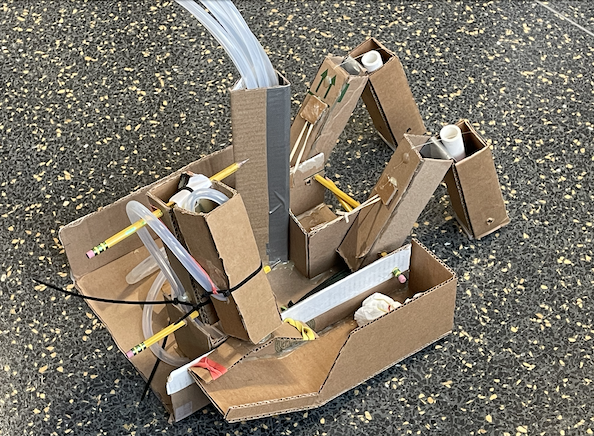
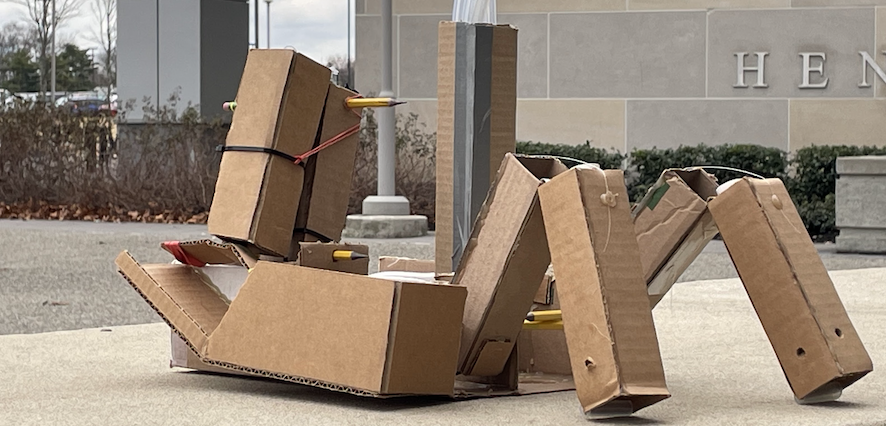
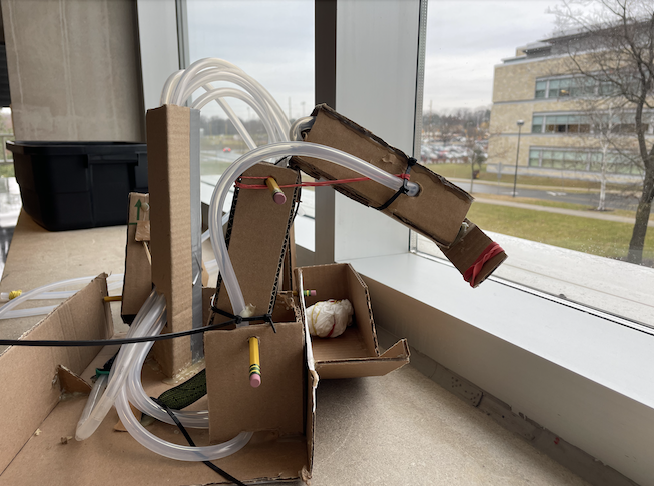
The McKibben Creature is a low-cost robot that is solely actuated by McKibben muscles. Materials such as corrugated cardboard and other readily available materials can be used for construction. All robots must address 3 challenges: locomotion, collection, and storage. Students will be working in teams of 3-4 to design and produce these robots. At the end of the project, students will compete in a simulated environment to collect small “food” tokens. Tokens can be placed at varying elevation levels with differing values of points.
This report has been written into a peer-reviewed conference paper. For further details into the curricular context of this particular project, please refer to the paper [1].
Design and build a soft robotic system actuated by McKibben artificial muscles. Students will apply pneumatic actuation principles to create a mobile robot capable of locomotion, object collection, and competitive task completion.
Course Implementation
Potential Course(s) Implemented:
- First-year Engineering course
- Sophomore-year Engineering course
- Highschool STEM related courses
Pre-requisite courses/topics needed: N/A
Expected Timeline: 8-11 Weeks
Learning Outcomes:
- Applying knowledge of mechanical forces and torque
- Practice approaching design challenges parametrically
- Optimize a product design given constraints
- Design a soft robotic system to accomplish a task
- Evaluating competitors and stategizing design
Learning Objectives
-
Students will:
-
Construct and operate a McKibben artificial muscle
-
Convert linear contraction into mechanical motion
-
Apply torque and force balance principles
-
Design and iterate a soft robotic locomotion system
-
Compete in a structured performance challenge
-
Document design decisions and results in a final report
-
Theory
1. Pneumatic Actuation Principle
Pneumatic actuators convert fluid energy (typically compressed air) into mechanical motion [2]. In soft robotics, this energy is introduced into flexible chambers, causing controlled deformation rather than rigid movement.
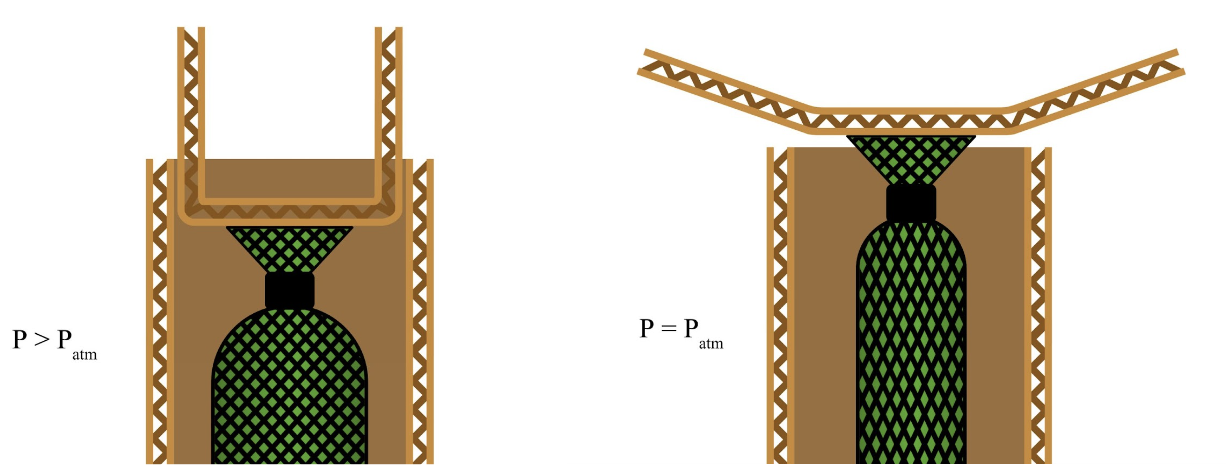
One of the most widely used pneumatic soft actuators is the McKibben artificial muscle, originally patented by Richard Gaylord (1958) [3]. When internal pressure increases, the braided sleeve constrains radial expansion and converts it into linear contraction.
As pressure increases:
-
The actuator diameter increases
-
The braid angle changes
-
The overall length decreases
This produces controllable linear contraction similar to biological muscle behavior.
At a simplified level, the generated force is proportional to internal pressure and effective cross-sectional area:
Force ≈ Pressure × Area
While real behavior depends on braid geometry and material compliance, this relationship provides the foundational understanding for actuator force output.

2. Contraction Behavior of the McKibben Muscle
As internal pressure increases from atmospheric to elevated pressure levels, the actuator contracts in stages. The relative pressure change determines contraction magnitude and force output.
This behavior is governed by:
-
Internal pressure
-
Braid angle
-
Actuator length
-
Material stiffness
Understanding these variables allows students to predict contraction force and displacement under controlled pressure inputs.
3. Leg Mechanism and Force Generation
The McKibben muscle in this project is used to actuate a leg mechanism. The contraction force generates torque about a pivot point, producing motion at the foot.
When actuated:
-
Muscle contraction produces a backward and downward force at the foot
-
Ground reaction forces increase grip
-
The system generates forward propulsion
When pressure is released:
-
The return element restores the leg position
-
Ground reaction shifts
-
The leg resets for the next cycle
This alternating interaction produces locomotion.

4. Torque Analysis
To analyze the leg, we apply the basic torque equation:
T = F · d
Where:
-
T = torque about the pivot
-
F = applied force
-
d = perpendicular distance from pivot to force line of action
It is important to note that d is measured from the pivot to the line of action of the force, not simply the point where the force is applied.

5. Combined Force Balance
When the foot is stationary and the system is analyzed statically, multiple forces contribute to the torque about the pivot.
The combined torque relationship can be written as:
T = Ff df + Fb db + Fm dm
Where:
-
Ff = foot reaction force
-
Fb = return band force
-
Fm = muscle force
-
df, db, dm = respective moment arms
This equation accounts for all forces acting on the leg system and allows students to model equilibrium conditions and predict system behavior.

6. Key Learning Concepts
Through this analysis, students develop understanding of:
-
Pressure-to-force conversion
-
Torque and moment arms
-
Multi-force equilibrium
-
Mechanical advantage in linkage systems
-
Converting linear contraction into locomotion
This theory connects soft robotics to core mechanical engineering principles including statics, mechanics of materials, and fluid pressure systems.
Materials & Equipment
Core Components
McKibben Muscle
-
½” Nylon braided sleeve
-
Latex balloons
-
Zip ties
-
Hot glue
-
60 mL plastic syringes
-
Silicone tubing
Creature Body
-
Cardboard (or rigid lightweight material)
-
Optional: Duct tape
Collection Tokens
-
Paper towel/napkin (crumpled)
-
Rubber bands
Tools
-
Box cutters
-
Cutting boards
-
Scissors
-
Optional: Pliers, wire cutter
📄 Download Full Bill of Materials
Project Phases
Phase 0 – Actuation Introduction
-
Introduce McKibben muscle behavior
-
Build and test artificial muscle
-
Review project goals and competition criteria
-
Develop preliminary robot concept
Phase 1 – Locomotion
-
Design mechanism for forward motion
-
Consider directional control and reversibility
-
Test under load conditions
Phase 2 – Collection
-
Develop mechanism to collect “food” tokens
-
Optimize for reach and efficiency
-
Validate performance through testing
Phase 3 – Storage & Refinement
-
Improve reliability and structural stability
-
Optimize collection + locomotion integration
-
Iterate design based on test results
Phase 4 – Final Competition
-
Teams compete in timed challenge
-
Points awarded based on collection height and quantity
-
Bonus points for efficiency and performance
Competition Duration: 10–20 minutes
Higher elevation tokens = higher point value
Evaluation & Deliverables
Students must submit:
-
Design documentation
-
Force and torque analysis
-
Performance results
-
Comparison of predicted vs measured behavior
Evaluation Criteria:
-
Proper application of theory
-
Functional locomotion
-
Collection effectiveness
-
Engineering documentation quality
Contributors
Joseph Midiri / Kathy Trieu / Douglas Snyder
References
[1] Midiri, J. R., & Trieu, K., & Xue, W., & Trkov, M., & Jamison, C. S. E., & Bakrania, S. (2024, June), BYOE: McKibben Creature - A Low-Cost Robotic Simulation of A Biological Environment Paper presented at 2024 ASEE Annual Conference & Exposition, Portland, Oregon. 10.18260/1-2--48435
[2] “What Is a Pneumatic Actuator and How Do They Work?” Process Industry Forum, www.processindustryforum.com/article/what-is-a-pneumatic-actuator. Accessed 15 Mar. 2024.
[3] R. H. Gaylord, “Fluid actuated motor system and stroking device,” 2844126, Jul. 22, 1958 [Online]. Available: https://patents.google.com/patent/US2844126A/en
Theory Application
Understand the acutation principle and underlying engineering theory applies to this project.
Project Description
See the breakdown of how this project will be implemented in a course including instructor prep, materials, and phase timeline.
Sample Prototype
See how the developers fabricated the prototype of this project.