I've been getting a few questions lately about Comet 3I/ATLAS, which will make its closest approach to Earth this week before speeding out of our solar system forever. So, I figure it's time to write a post about it to answer some of the common questions I've heard.
The most frequent question I get is, "What is 3I/ATLAS, really?" The internet has been full of conspiracy theories and extraterrestrial-loving "experts" claiming that this comet is an alien spacecraft that has left NASA stunned by its behavior and other similarly wild and unsubstantiated claims. So, let's clear the air. No, it's not aliens. As astronomer Phil Plait said, "It's never aliens."
"But a Harvard astrophysicist says that it is aliens." Yes, he did. He has been making accusations about aliens for nearly a decade, since the first interstellar comet, 1I/Oumuamua, passed through our solar system in 2017. He has made a lot of money from his alien claims, including book deals and his Galileo Project research initiative to "prove" aliens exist. But astronomers and astrophysicists worldwide have debunked his claims, questioned his research methodology, and called out his numerous conflicts of interest (here's one such example). Just because one scientist makes a claim does not make it real, regardless of which institution they work for.
So, if it's not aliens, what is 3I/ATLAS?
3I/ATLAS is an extrasolar comet - a comet that didn't originate in our solar system but some other star system in our vast Milky Way galaxy. It's the third such comet discovered, though there are likely dozens in our solar system at any given time; we just haven't detected them yet. However, that could soon change as the Vera Rubin Observatory begins operations, creating a vast inventory of solar system bodies, including comets and asteroids.
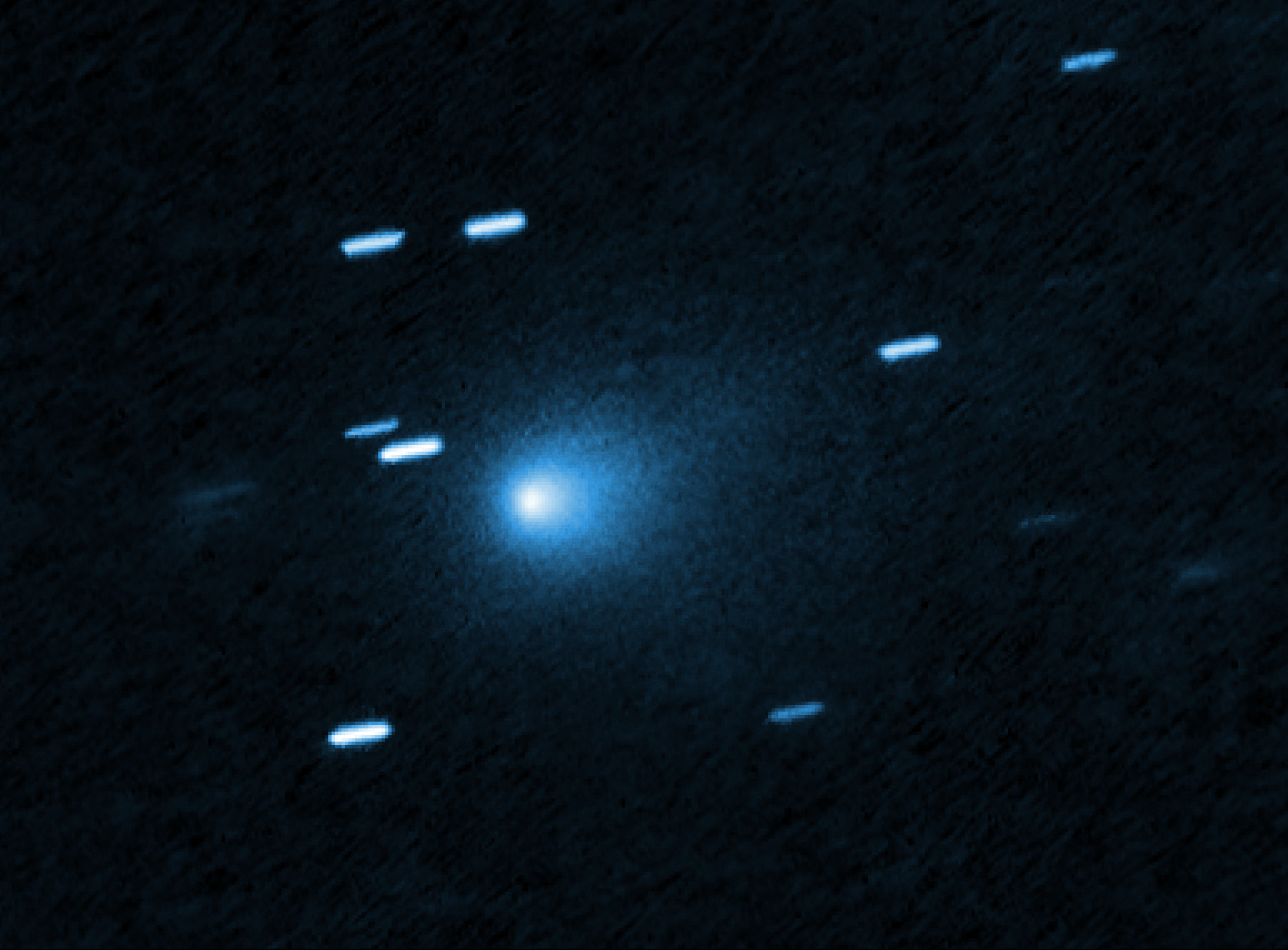
Comet 3I/ATLAS appears as a fuzzy blue blob in the center of this image from the Hubble Space Telescope. The streaks are caused by background stars "moving" as the telescope tracks with the fast-moving comet.
Since its discovery in July of this year, scientists around the globe have been trying to capture as much information as they can about this interstellar visitor before it leaves the solar system. They have turned every available telescope and space observatory to this transient comet, even some that were never designed to look at comets, such as the solar observatories SOHO and PUNCH, and NASA's Mars-based spacecraft MRO, MAVEN, and Perseverance. Hubble, Webb, Lucy, and Pysche have also pointed their instruments at 3I/ATLAS to discover as much as we can before it's too late. Though the pictures may not look like the beautiful images we expect from these space-based telescopes, they are still valuable to astronomers, helping refine estimates of size and speed, as well as the characteristics and makeup of this icy body. It's actually really impressive that many of these observatories saw anything at all, given that they weren't designed to look at fast-moving comets! The sometimes fuzzy or pixelated images do not mean that NASA or other space agencies are hiding information or trying to cover up the truth. They are instead a testament to just how small and distant 3I/ATLAS is from these spacecraft. Engineers really had to stretch their instruments' capabilities to collect the data they did.
How big is 3I/ATLAS?
3I/ATLAS's size is not yet well-defined, but it is estimated to be at least 1,400 feet and no more than 3.5 miles in diameter. The bright coma of comets makes it difficult to determine the exact size.
Just how fast is comet 3I/ATLAS traveling?
When 3I/ATLAS entered our solar system, it was moving at about 38 miles per second (137,000 miles per hour) and has since sped up to 42.5 miles per second (153,000 mph) after its close pass by the Sun. It will take some time for scientists to comb through and analyze all the data gathered from these observations. We can expect a lot more information about 3I/ATLAS in 2026.
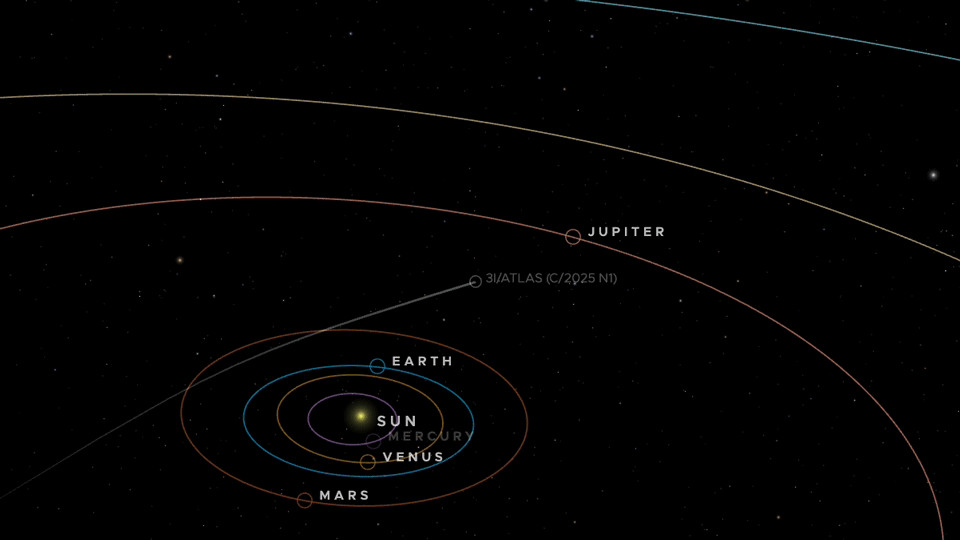
3I/ATLAS is pretty consistent with other comets we've detected. It's an icy body whose gases are being expelled as they heat up from the Sun's radiation, creating a coma and tail. Its age is estimated to be around 7 billion years old - almost twice as old as our solar system!
Can I see the comet?
When it makes its closest approach on December 19, 3I/ATLAS will still be very far away - about 170 million miles from us. There is no chance that this comet could hit Earth. But there is a chance that you can view it for yourself. 3I/ATLAS is below the constellation Leo in the early morning sky. You will need dark skies and a moderately sized telescope (at least 4" or 100mm diameter) or a smart telescope (such as the Seestar) to observe it. It won't be as spectacular as some of the recent comets with a long, bright tail. It will instead appear as a faint, fuzzy ball. If you use an astrophotography rig to photograph the comet, you may even see a greenish hue to it.
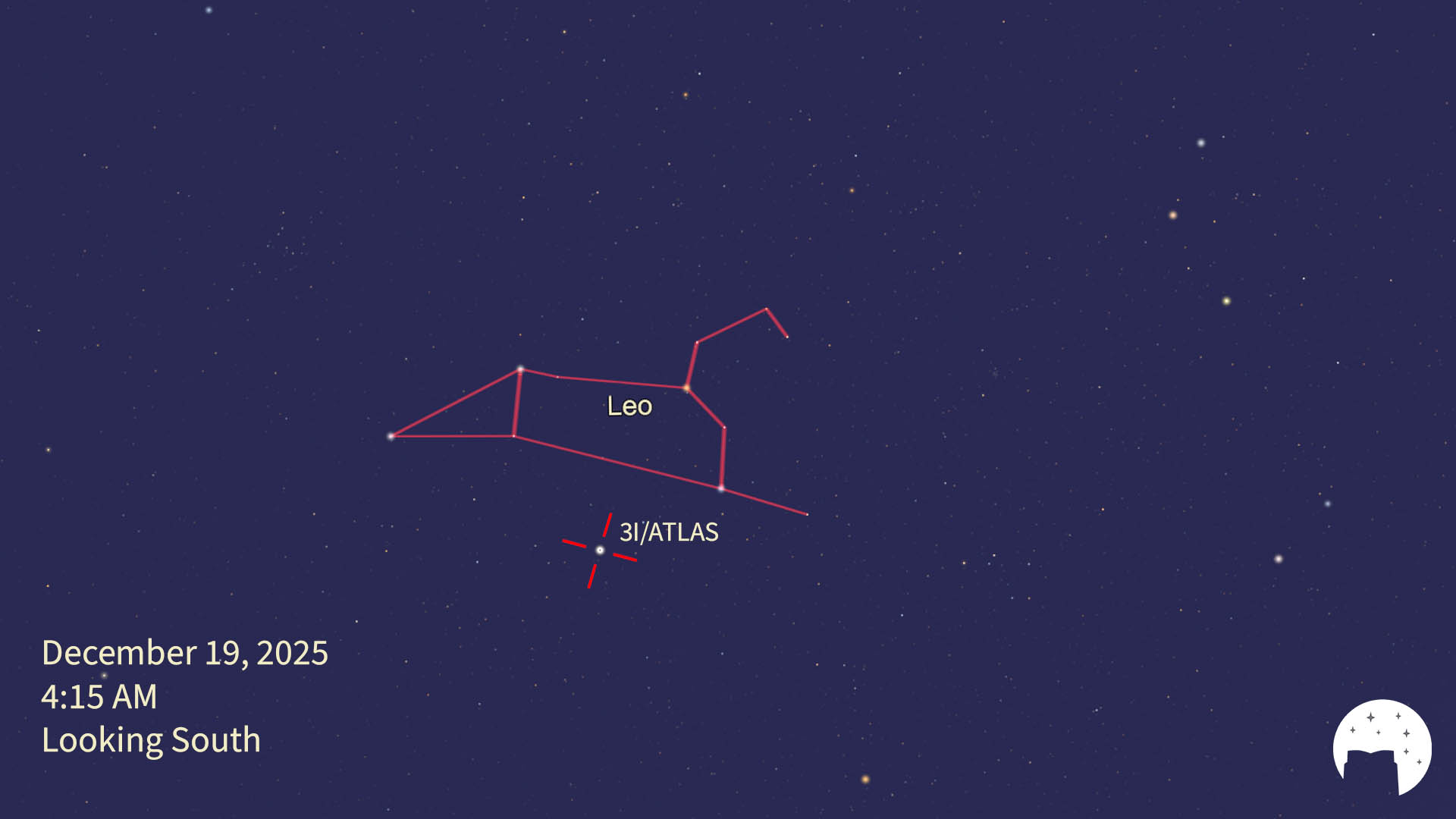
If you don't have the necessary equipment, or it's just too cold for you to want to trudge through the snow with your scope, the Virtual Telescope Project has you covered. They will be livestreaming the event on YouTube.
Whether you view the live stream, enjoy images from the world's observatories, or head out to view it yourself, it's a rare opportunity to view an object from the distant reaches of our galaxy. Our solar system may be one of several star systems it has passed since it was flung out from its host star. I wonder what it has witnessed on its cosmic journey?