The International Space Station will be making a few bright passes over South Jersey over the next few days. This orbiting laboratory is moving so fast that it orbits the Earth every 90 minutes! Find out how to see it for yourself with our guide.
You'll have to get up early to spot these passes, but they're very bright and should be worth your time. Check the weather before setting your alarm to ensure the skies will be clear. There's no point in getting up early to see the station if it's cloudy! Use the star charts and tables below to spot it.
Remember that an object's brightness is measured using an inverse logarithmic scale, meaning that the brighter something is, the smaller its magnitude will be. Each step in magnitude corresponds to a change in brightness of 2.5 times. A star with a magnitude of -1 is 2.5 times brighter than a star with a magnitude of 0. At their brightest, planets like Jupiter and Mars have a magnitude of -3. Venus's max brightness is -5.
A few planets will also be out, so be sure to enjoy views of Jupiter and Venus while you're up.
November 1
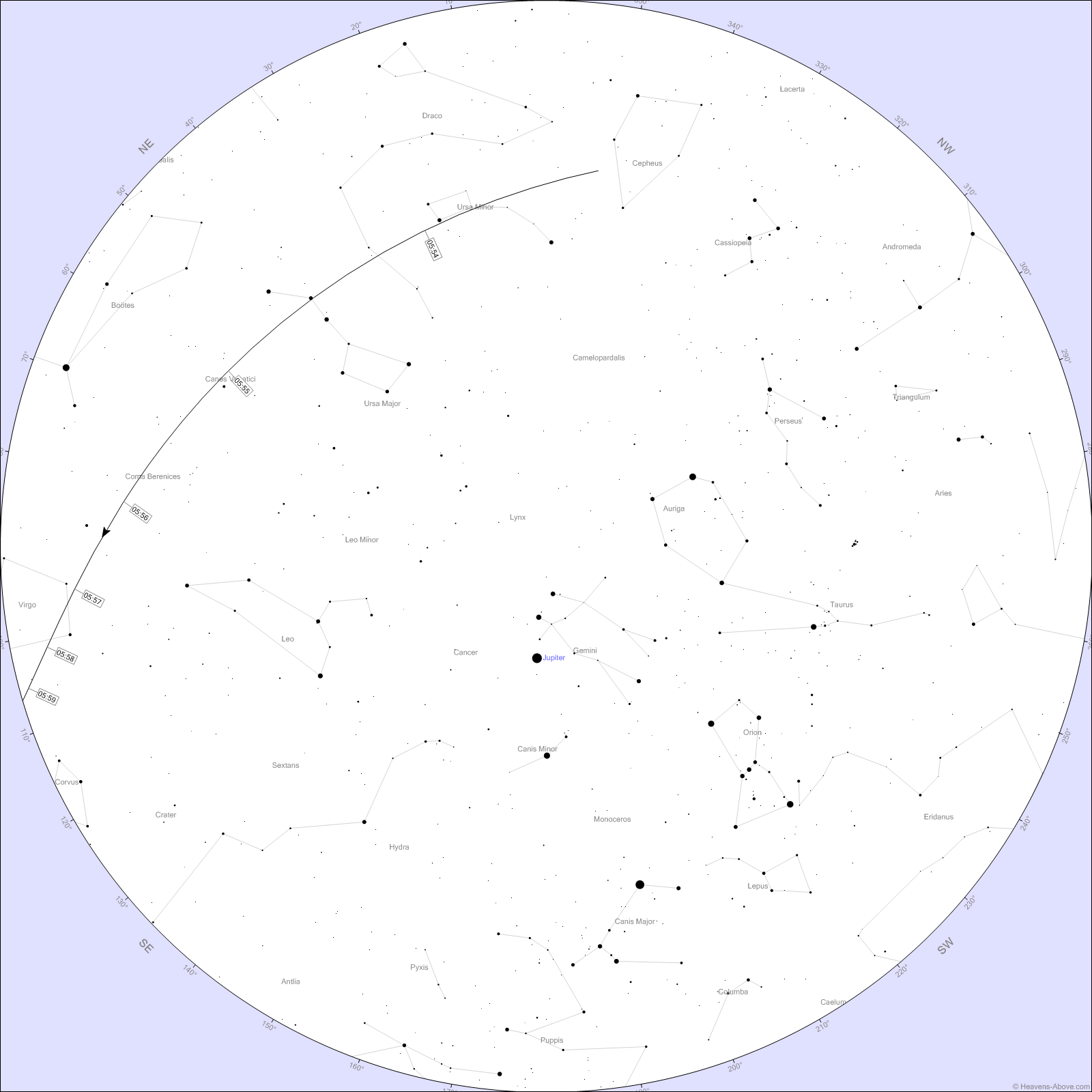
The first pass will occur just before 6 a.m. on the morning of November 1st. The ISS will appear almost due north in front of the constellation Cepheus. It will then travel east through the bowl of the Little Dipper and the handle of the Big Dipper before setting in the east near Virgo.
| Event | Time | Magnitude (Brightness) |
| ISS Appears | 5:53:11 AM | -2.4 |
| Maximum Altitude | 5:54:12 AM | -2.4 |
| ISS Sets | 5:59:31 AM | 1.6 |
November 2
The next pass will happen the following morning, November 2, about 10 minutes earlier than the previous night's pass.
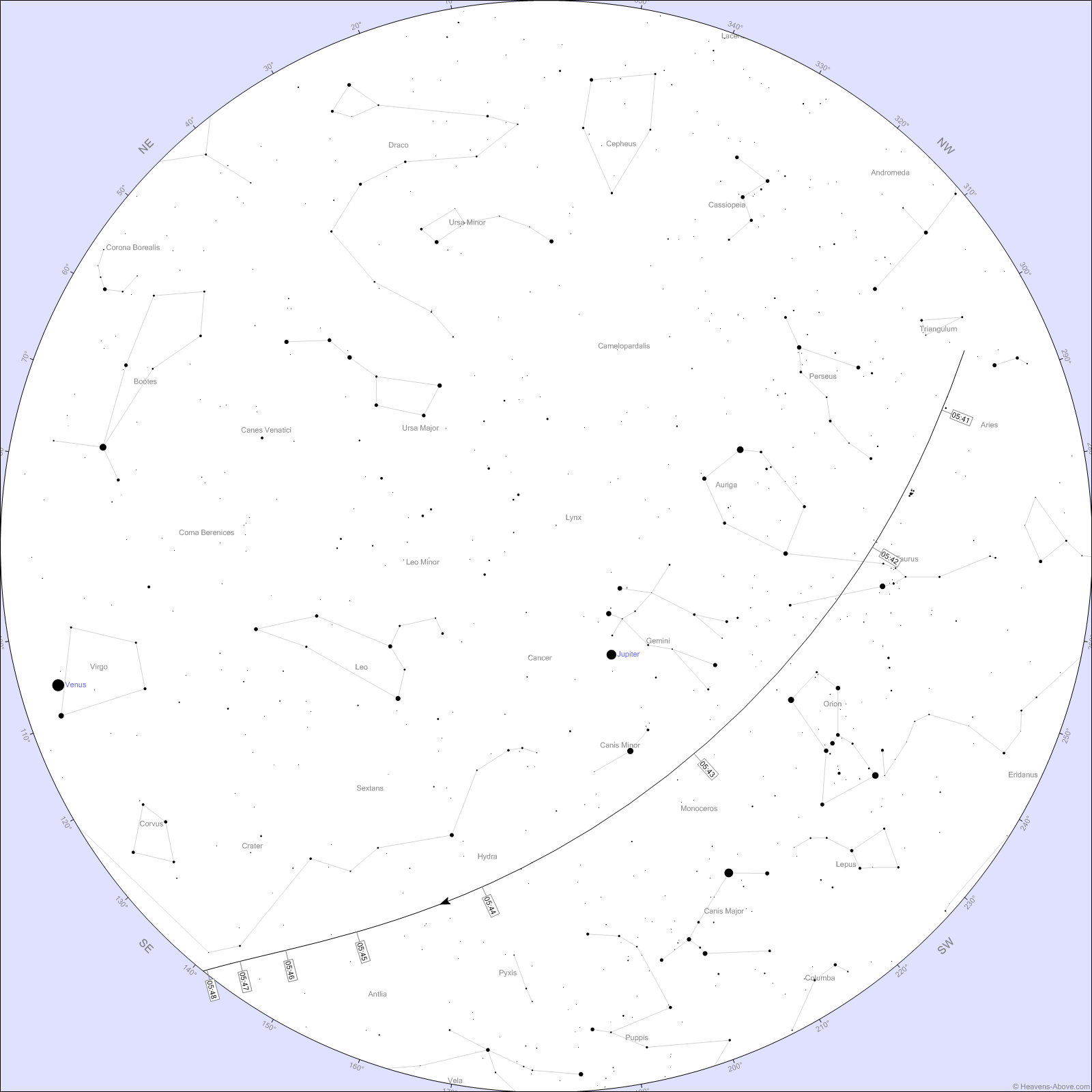
This time, the ISS will appear near the faint constellation Triangulum in the northwest before passing over the sky to the southeast. It'll pass just above the bright star Aldebaran in Taurus, then between the constellations Gemini and Orion, making a pass about halfway between Jupiter and the brightest star in the night sky, Sirius.
| Event | Time | Magnitude (Brightness) |
| ISS Appears | 5:40:16 AM | -2.0 |
| Maximum Altitude | 5:42:53 AM | -3.4 |
| ISS Sets | 5:48:15 AM | 0.9 |
November 3
The last really good pass of the space station in this cycle occurs on November 3.
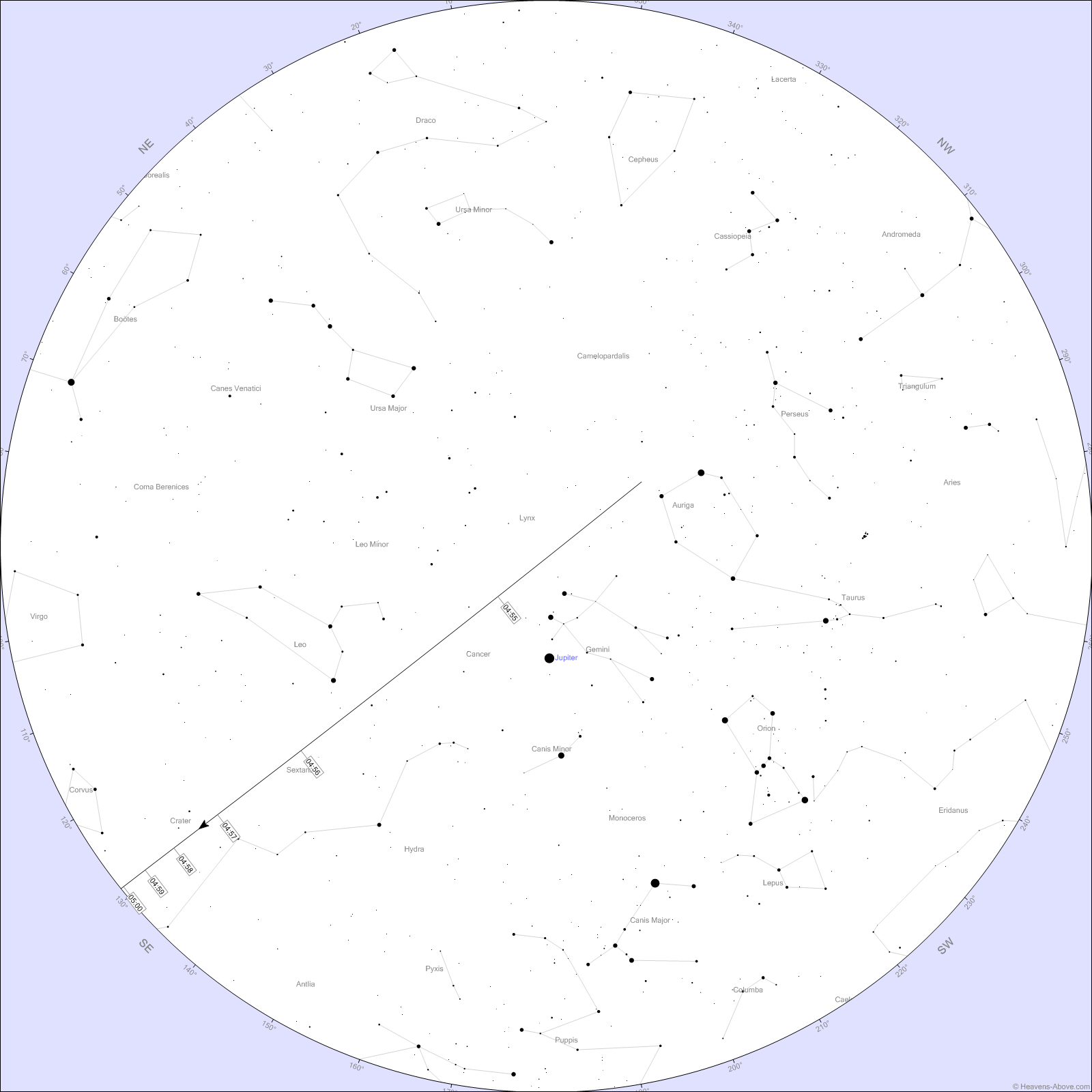
This last pass will be shorter, with the ISS appearing near the zenith, the highest point in the night sky. It starts near the bright star Capella in Auriga before moving southeast above Castor and Pollux in Gemini. It will continue its southeastward journey, passing Regulus in Leo and finally setting near the constellation Crater, the Cup.
| Event | Time | Magnitude (Brightness) |
| ISS Appears | 4:54:29 AM | -3.9 |
| Maximum Altitude | 4:54:47 AM | -3.9 |
| ISS Sets | 5:00:14 AM | 1.0 |