Engineering an Entrepreneurial Mindset
Engineering an Entrepreneurial Mindset
Built ‘from scratch’: Rowan University engineers fly drone swarms around the world
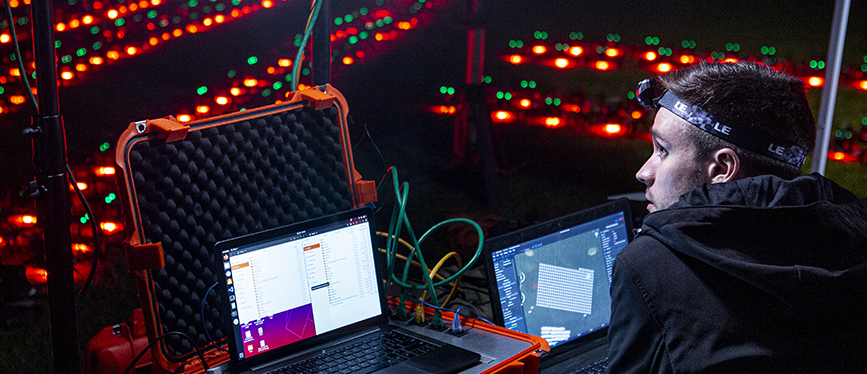
On a recent, chilly midnight, hundreds of drones lifted above Rowan University’s West Campus in tightly synchronized formation, their brilliant LED bellies filling the sky with color-changing patterns. Scattered on the athletic fields below the buzzing quadcopters, a handful of spectators erupted in cheers.
At that moment, it was the largest demonstration of the proprietary swarm technology developed by Philadelphia-based Verge Aero, a startup company flying complex aerial light shows for audiences around the world.
Except this time, the company’s engineers and co-founders were back on their home turf.
Since launching their business in 2016, three Rowan University alumni—Tony Samaritano, Chris Franzwa and Anthony Merlino—have maintained close ties to the southern New Jersey university that gave rise to their company: borrowing space to use as a test site, recruiting undergraduates as interns and exchanging ideas with faculty.
“This is what a Rowan engineering education can do,” said Dr. Giuseppe R. Palmese, dean of the Henry M. Rowan College of Engineering. “Our small classes and hands-on, real-world clinic projects are designed to inspire our students to use their imagination and aim high. Verge Aero is a prime example of the impact we make.”
Rowan also seeks to instill an entrepreneurial mindset in its students, noted Dr. Robi Polikar, who heads Rowan’s Department of Electrical & Computer Engineering.
PARTNER WITH US:
Need experts, space, resources and/or people? Tell us how we can help.
“To be able to see that they have taken a concept that started as a course project while they were students in our program and built this, literally from scratch, one drone at a time is an immense point of pride for us,” Polikar said, “and represents the best of what our program offers.”
The college was formed after Henry M. Rowan and his wife, Betty, made a transformational $100 million gift to the former Glassboro State College in 1992, then the largest gift ever made to a public college or university. The Rowans requested only that the institution form an engineering college with a curriculum that would address the shortcomings of engineering education.
Now in its 25th year, the Henry M. Rowan College of Engineering remains a place where, in its benefactor’s words, “you roll up your sleeves and get down to work.” Verge Aero’s three founders met as undergraduates at Rowan, where they picked up the microprocessing, communication theory and technical skills they would later need to develop their company and its drone-powered light shows from the ground up.
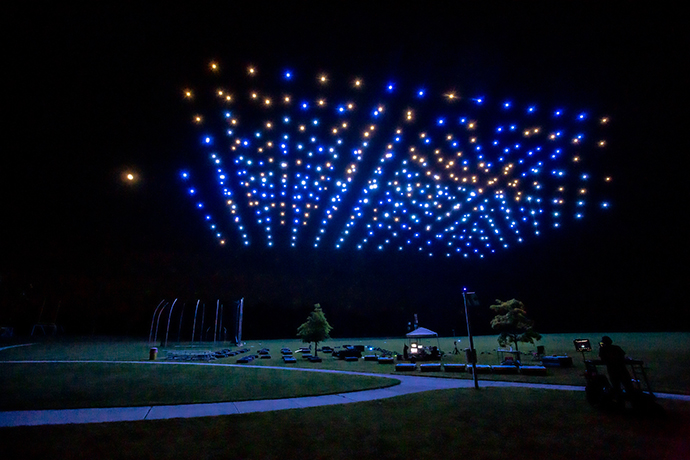
Abandoning promising industry careers in favor of their entrepreneurial goals, the three spent years programming the system’s back end, so they could quickly design and produce intricate shows on the fly with just a small crew.
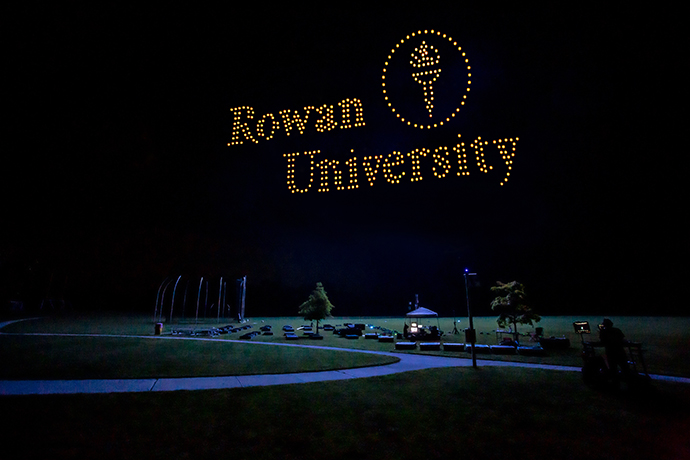
“They’re like high-tech fireworks,” said Samaritano, who earned his bachelor’s and master’s degrees in electrical and computer engineering in 2012 and 2018. “We can dynamically build shapes in the sky and spell out logos—and we do this for some of the biggest names around the world.”
Indeed, when Joe Biden celebrated his presidential win in Delaware on Nov. 7, 2020, the fireworks display featured patriotic graphics emblazoned on the night sky by 200 drones piloted by Verge Aero. The company’s drones have flown at festivals including Burning Man in Nevada and Carnaval in Mexico, as well as concerts and shows hosted by well-known companies.
But arranging up to 600 drones for the test flight at Rowan required many more hands—and offered an opportunity to mentor undergraduates from their alma mater.
To find skilled volunteers, Samaritano reached out to the president of the student club he started nearly a decade ago: the Rowan Robotics and Automation Society. Jack Campanella, a senior electrical and computer engineering major, spent last summer interning for Verge Aero and quickly enlisted help from his club members for the test run.
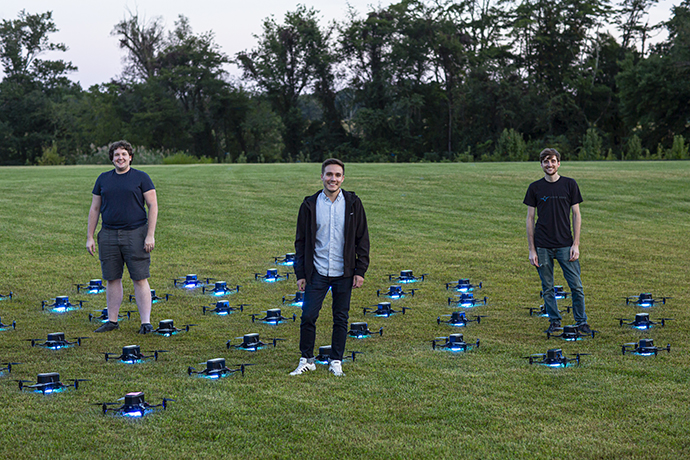 “They’re really great people who were, at one point, in the same position as us,” said Campanella.
Indeed, as an undergraduate, Merlino built drones from scratch, well before the flying robots were commercially available, using parts purchased with his professors’ permission.
Dr. John Schmalzel, the electrical and computer engineering department’s founding chair, recalled the first flight vividly. Concerned it might “crash into something,” he told his student to keep the drone tethered. Today, Schmalzel sees no limits for Verge Aero’s swarm technology, even beyond its entertainment value. The company recently donated one of its drones for a Rowan clinic project developing an agricultural application.
“When I look at their technology, I see so much potential for it,” said Schmalzel.
For now, the company is focused on wowing audiences. On the test date, Rowan students spent hours setting up blinking drones, lining them up in a grid pattern on the grass. When the drones launched, they cheered and marveled at the technical feat hovering overhead.
A few weeks later, Verge Aero successfully flew a 600-drone show at the Electric Daisy Carnival in Las Vegas. The company’s engineers credited their success to the educational foundation developed at a fast-growing public research university in southern New Jersey.
“Without Rowan, I wouldn’t have had the confidence to be able to build a company from scratch,” Samaritano said.
 “I think of a lot of schools where you’re sitting in a lecture hall filled with hundreds of people and you’re struggling to get lab time,” Franzwa added. “Here, I was able to just work as much as I wanted.”
Merlino appreciated Rowan’s clinic classes that gave him the freedom to feed his interests and curiosity—and allowed him to create something new.
“Theory’s great, but at the end of the day, the thing that builds companies is practical, hands-on stuff,” Merlino said.
As more Rowan students roll up their sleeves and get down to work, the potential for solutions and discovery abound.
“Hands-on, cross-disciplinary projects result in interactions that spur creative thinking and problem-solving,” Palmese said. “Seeing an innovative and successful company arise from our educational efforts is rewarding to our faculty—and it’s a testament to Mr. Henry Rowan’s legacy.”